Articles

Updated:
Character designs for Mongrel: The Legend of Copperhead.

The George A. Romero Archival Collection contains literally hundreds of drafts from unproduced projects, including at least 80 that seem to be unique projects begun by Romero himself or in collaboration with another writer. There are other projects that began as a script by someone else, or which seem to be screenplays that Romero acquired or was sent but never worked on (including a screenplay written by Let's Scare Jessica to Death writer Lee Kalcheim adapting his acclaimed play, Friends, and a draft of Peter Jackson, Fran Walsh, and Phillippa Boyens' Lord of the Rings: The Fellowship of the Ring).

One of the most intriguing, exciting projects was a film to be co-produced by Marvel Comics that Romero conceived with the legendary Jim Shooter (a fellow Pittsburgher!) called, variously, Copperhead, Mongrel: The Legend of Copperhead, or Copperhead Conquers the Warhawks. We have several drafts in the archive from the early 1980s, including an "illustrated story" that summarizes the action with illustrations for each scene. It's a science fiction epic, set in a world of space travel and robots and hyper-advanced military technology in which rebels are fighting against a rigidly militaristic, fascist system. "Copperhead" is the hero, a soldier transformed into a Robocop-like fighting machine (several years BEFORE Robocop, to be clear) and sent to seek out and eradicate the rebel "terrorists" who supposedly destroyed his home city. The scope of the story expands as it progresses, climaxing with Copperhead fighting alongside the rebels as various sides attempt to gain control of a massive stockpile of nuclear weapons. The story is wild and fun and, like all of Romero's projects, fundamentally political.

Romero and Shooter worked on the project over the course of several years (our materials are dated between 1982 and 1984), with the project evolving in each iteration. Alongside the drafts we have a collection of slides, color illustrations of character designs and action set-pieces.

This wasn't the last time Romero and Shooter would work together. In the late 1990s, as Romero was pondering a return to zombies with a Resident Evil adaptation, a Night of the Living Dead television series, and a script first called "Dead Reckoning" that would be filmed and released as Land of the Dead, he would also be working on big screen adapation of the Shooter-created Shadowman. For anyone familiar with the characters and the mythology that Shooter and his fellow Valiant Comics creators developed, this would have been a particularly intriguing project for the director of Night of the Living Dead, as it would have melded Romero's own approach to the undead with the traditions of Haitian Vodoun. 


Updated:
The Six Phases of Film Production

Without any additional context, this sheet was included in the middle of Romero's production. We don't know where it came from, but it's a wryly humorous (and depressingly accurate!) summary of Romero's experiences in the film industry. 


The Six Phases of Film Production

  1. Wild enthusiasm
  2. Disillusionment
  3. Panic
  4. Search for the guilty
  5. Punishment of the innocent
  6. Reward of the non-involved
Updated:
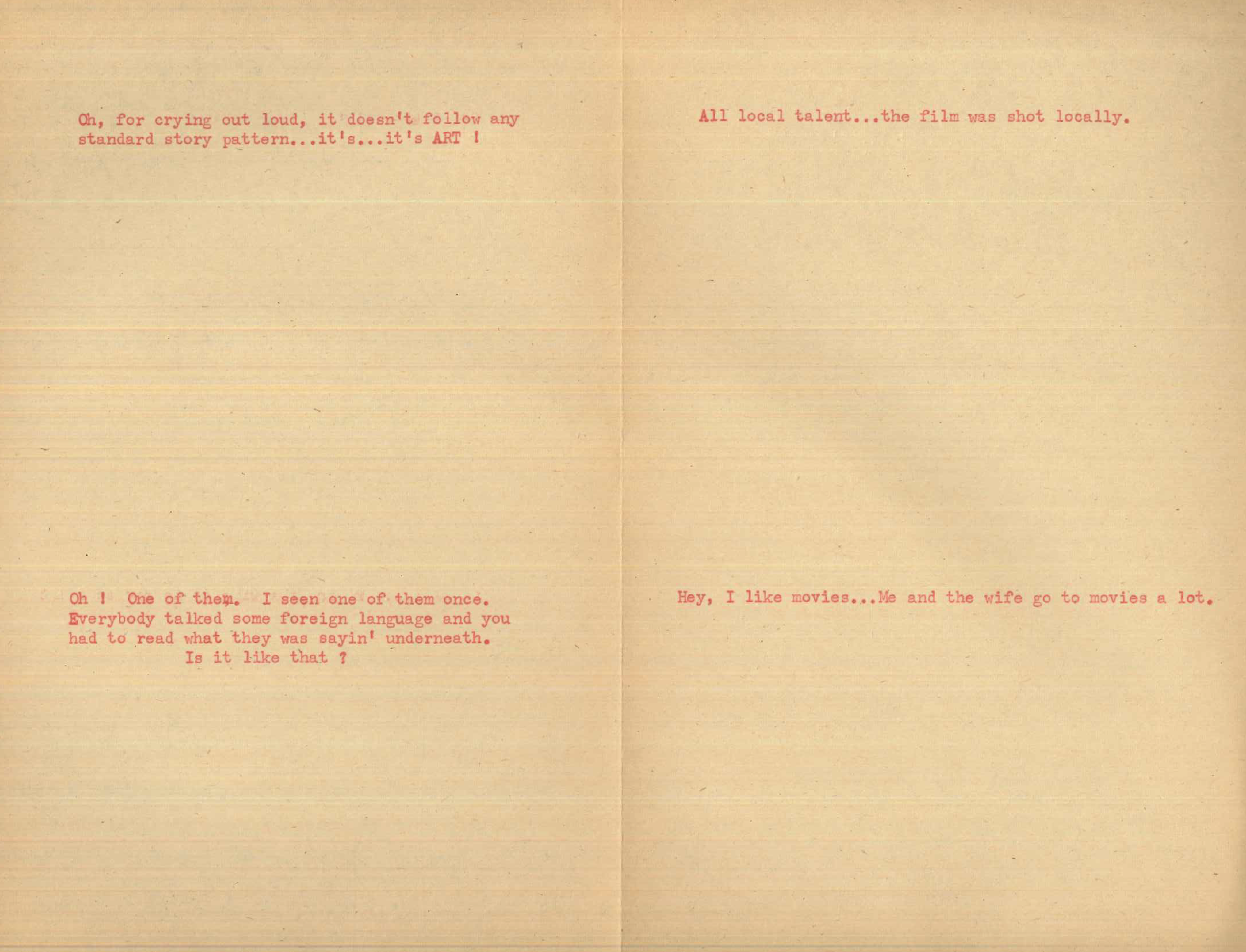
A page from the fundraising booklet for Expostulations.

It's little known that Night of the Living Dead was not actually Romero's first feature film. The first was a mostly-lost anthology film from the early 1960s called Expostulations. According to Romero, it was fully shot and edited but it was shot silent - as was customary for low-budget independent filmmaking at the time - and the company hired to create and record the soundtrack went out of business. It's unclear what happened to the footage, but some footage (from a segment by Richard Ricci starring future NFL fullback Robert Brooks) has resurfaced. In an unpublished interview from the 1990s, George described the film as follows:

The film was an anthology containing five short stories written by myself, Rudy [Ricci], and (the biggest contributor) Rudy's cousin Richard Ricci, who wrote the two longest set-pieces, 'Connection,' a poem (which we visualized) about blacks driven to crime in the inner city, and 'A Door Against the Rain,' the closest to a 'real movie,' a story about a poverty-stricken boy whose grandfather builds him a free-standing door in an empty lot. The boy moves through the door into imagined places.

The other three pieces... Mine - 'Average Morning' (a montage of images depicting a commuter's morning) and 'The Framistan' (a slapstick about a scientist who creates a machine which makes people disappear); Rudy's 'The Rocketship' (also slapstick, about a two-inch-long rocket from space which lands in a man's ice cream cone at an amusement park... seen through the eyes of the rocketship's crew).... were quite frivolous compared to Richard's.

It was an ambitious project. We were seriously dedicated to it, and, most important, we finished it (at two and a half hours). We worked with real actors (friends from CMU and from The Pittsburgh Playhouse). We build elaborate sets, props, etc. It was really our first 'professional' work.

In trying to provide a musical score for Expostulations, we got involved with a small audio recording company in Pittsburgh, Lavere Music. After a short time, Lavere went bankrupt. We secured a business loan and took over their office and studio space which we still occupied in 1984 (as Laurel). Expostulations, in my mind, represents the real beginning of my career. It was the first time I could possibly achieve something as a filmmaker.

In the archive, we only have one item from the film: a promotional booklet created to raise funds  for the production. It contains surprisingly little information about the film! Without any narrative description, images from the film, or any specifics about the project, the booklet imagines a dialogue between the filmmakers behind Expostulations and an unsophisticated rube of a moviegoer who expects every film to be a genre movie with big stars and hot babes and a very familiar story. This project, in contrast, is ART. 

Updated:
Design for alien tripod for War of the Worlds

In 1986, George began what would have been an epic, two-part adaptation of H.G. Wells' foundational science fiction novel War of the Worlds. He completed a draft of the first part, "The Night They Came," which covered an on-the-ground account of humanity's attempts to survive the initial alien invasion. That screenplay ended with the humans starting to rise up and fight back, and an announcement of part two, "The Day of Combat." Along with the drafts of the first part, there were designs for the alien ships and machinery, including a unique take on the iconic tripod walkers from which the aliens attack.