Articles

Updated:
A reference to Night of the Living Dead in the first draft of Pet Sematary.

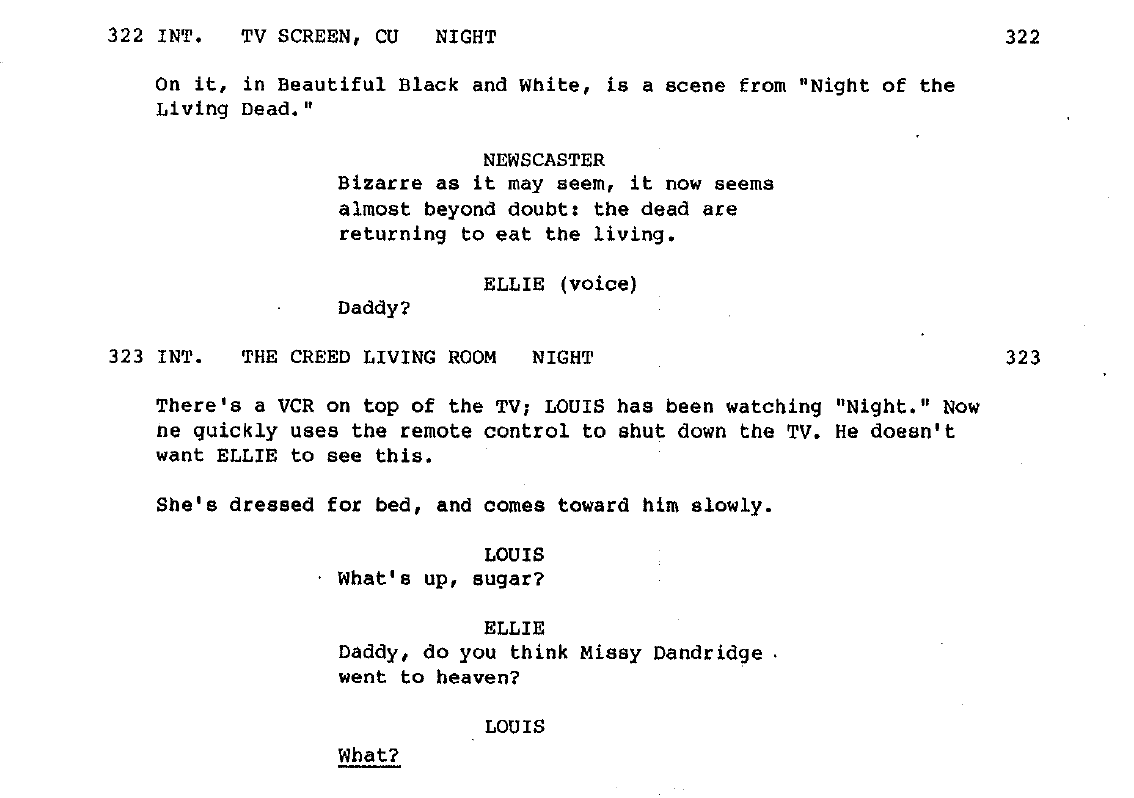
In the first draft of Stephen King's screenplay for Pet Sematary - which is, of course, about resurrecting the dead - George Romero's Night of the Living Dead makes an appearance. This first draft, dated November 15, 1984, is unfinished. It was written and originally developed with Romero as the intended director, but unfortunate timing led to the producer moving on from Romero and drafting the great Mary Lambert to create her own iconic version of King's novel. But Romero worked on develping the film with King for multiple years, getting far enough in the process for Romero to draw his own storyboards.

In the 1984 incomplete draft, Louis is watching Night of the Living Dead on TV "in Beautiful Black and White," when his daughter Ellie approaches to ask him "Daddy, do you think Missy Dandrige went to heaven?" 

The first full draft would be dated April 1985, and it would not retain the jokey reference to Romero's debut. 

It would, however, retain another in-joke, to Michael McDowell. McDowell is now best know as the writer of Beetlejuice and The Nightmare Before Christmas, but at the time he was a novelist who had worked with Romero on the Tales from the Darkside television series, including one adapting "The Word Processor of the Gods," a short story written by King and one of the series' signature episodes.

The relevant exchange, between young Ellie and her father Louis, comes almost exactly halfway through the script: 

ELLIE: At school Michael McDowell said she was gonna fry in hell. Michael McDowell says all sewersides fry in hell.

LOUIS: Well, I think Michael McDowell is so full of shit he probably squeeks [sic] when he walks... but don't you dare say that. 

The moral of this particular archival story would appear to be that Stephen King has a lot of fun when he writes, and that includes saluting and/or roasting his friends.


-Adam Charles Hart
Updated:
Night of the Living Dead TV series pilot.

In the late 1990s, George Romero began exploring the possibility of a TV adaptation of Night of the Living Dead, writing a treatment in 1997 that retold the beginnings of the zombie apocalypse from the perspective of a different cast of characters. In 2004, he adapted that idea to a style and structure modeled on The Blair Witch Project: the series would consist entirely of footage shot within the world of the film, primarily from the cameras of the film students that would be its main characters. After Land of the Dead was released to modest box office returns, Romero returned to the Night TV pilot script with the thought of making an ultra-low budget zombie movie, possibly with film students at Valencia College in Florida, and adapted it into Diary of the Dead. When a production company suggested a slightly larger budget with the prospect of a theatrical release, Romero added a few action setpieces to give viewers their money's worth, but, most importantly, he added one major character (Debra, the nominal protagonist of the film) but otherwise he otherwise kept most of that TV script with minimal changes. 

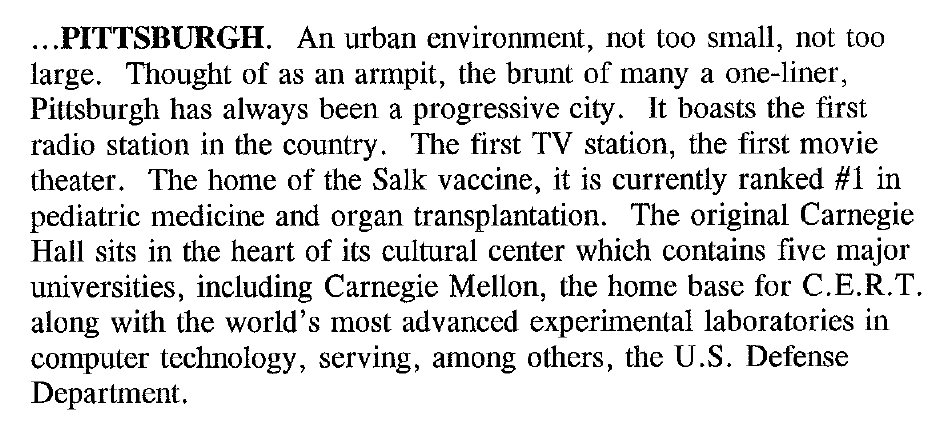
At this time, Romero had moved away from his longtime home of Pittsburgh, where he had lived and worked for most of his life. But he compensated by setting Land explicitly in downtown Pittsburgh, and making Diary's characters students at the University of Pittsburgh. There is a great deal to say about the evolution of all these projects, but I wanted to begin with this paragraph from the Night of the Living Dead TV pilot script describing his then-former hometown. If you wanted to know about the Steel City, this is as good an introduction as any.

...PITTSBURGH. An urban environment, not too small, not too large. Thought of as an armpit, the brunt of many a one-liner, Pittsburgh has always been a progressive city. It boasts the first radio station in the country. The first TV station, the first movie theater. The home of the Salk vaccine, it is currently ranked #1 in pediatric medicine and organ transplantation. The original Carnegie Hall sits in the heart of its cultural center which contains five major universities, including Carnegie Mellon, the home base for C.E.R.T., along with the world's most advanced experimental laboratories in computer technology, serving, among others, the U.S. Defense Department.


-Adam Charles Hart

Updated:
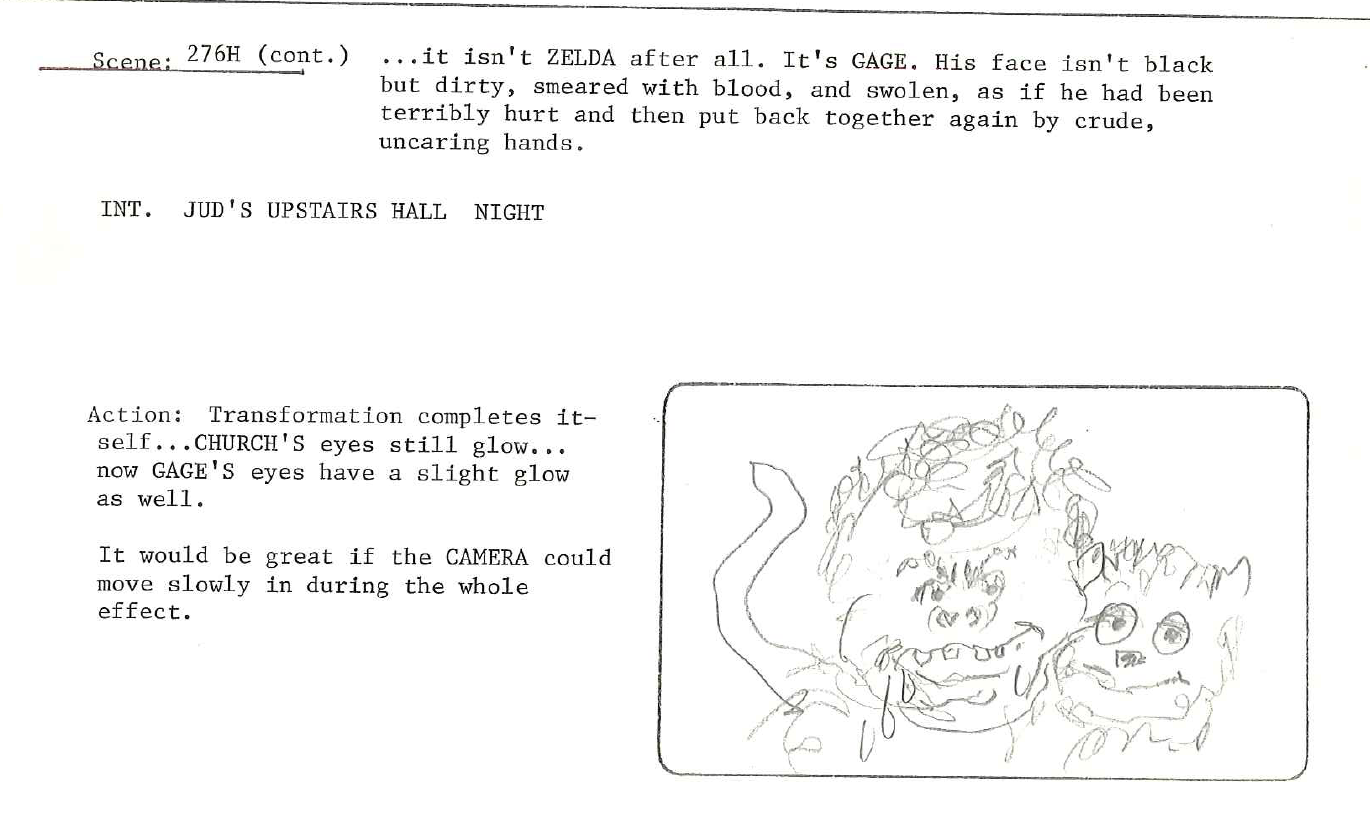
George Romero's storyboards for Pet Sematary.

George Romero worked for several years on an adaptation of Stephen King's Pet Sematary, but the timing never worked out. Between post-production on Day of the Dead and the development of Monkey Shines, Romero's schedule conflicted with the various windows of funding/production that opened up. It was, for him as for King, a very personal project that spoke to family and fatherhood in ways that were incredibly meaningful to him. Working from King's screenplay, the project came close enough to production with Romero at the helm that Romero storyboarded the project. 

King and Romero had sought to work together several times over the course of their careers, with Creepshow and The Dark Half being the only completed films. But Romero worked towards filming not just Pet Sematary but The Stand, It, Children of the Corn, and The Girl Who Loved Tom Gordon. The archive also contains a 1983 screenplay by King called The Shotgunners, which King would rework in the 1990s for his novel The Regulator.

Updated:
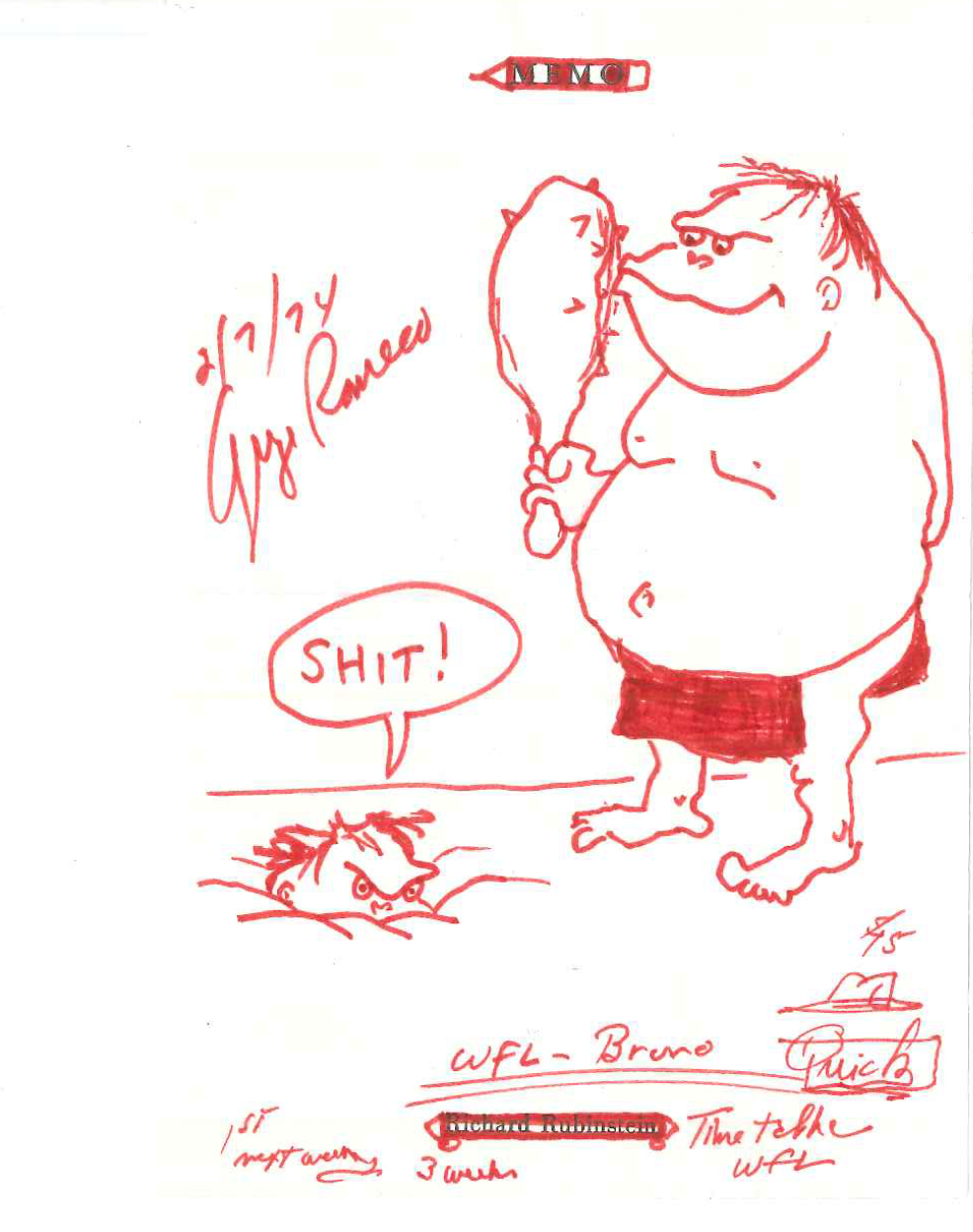
George Romero's Caveman Doodle

There are some clearly important, revelatory materials in the Romero archive, but sometimes the most entertaining bits are the ephemera. This utterly delightful doodle, signed by Romero and dated February 7, 1974, reprises a caveman design we've also found in a Latent Image Christmas Card (undated, but presumably December 1973). 

These sorts of seemingly random bits can be INCREDIBLY helpful for researchers, however. Because Romero dated this little bit of paper on producer Richard Rubinstein's stationary, that lets us date the rest of the info on the page: "WFL-Bruno." This blog will be posting more info and discussions of Romero's almost wholly unknown TV work from the 1970s in the coming weeks, but, briefly, he worked with Rubinstein to make a series of sports documentaries for television between 1973 and 1975. It was crucial to getting his career back on track after a series of flops (not to mention the lack of returns for Night of the Living Dead) left him in debt and unable to finance a new feature. "WFL" refers to a documentary on the World Football League, while "Bruno" refers to legendary Pittsburgh-based wrestler Bruno Sammartino. The latter film was directed by Romero, with interviews conducted by local newsman, horror host, wrestling enthusiast, and Night of the Living Dead actor "Chilly Billy" Bill Cardille, and it's a wonderful portrait of not just a performer but of the city. Thanks to this randomly saved bit of paper, we can now be reasonably certain that they were filming both simultaneously in February 1974. 


-Adam Charles Hart

Updated:
The crawl for Night of the Living Dead.

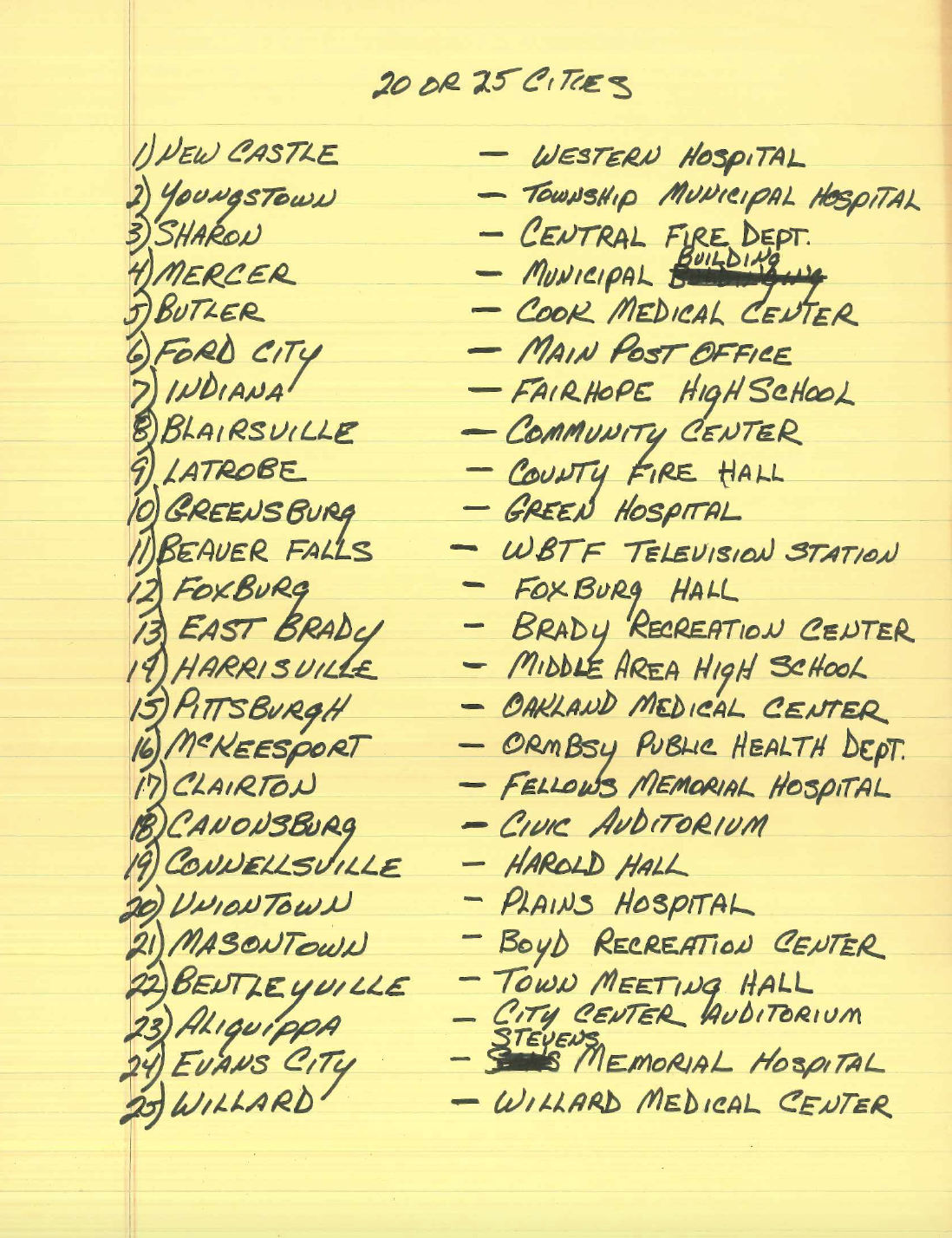
Among the materials for Night of the Living Dead, we found a handwritten sheet of notebook paper with the heading "20 or 25 Cities" at the top. It took us a minute, but we soon figured out what it was: this list would become the crawl at the bottom of the screen during the news broadcast in Night. These are all the safe destinations for survivors in southwest Pennsylvania as the dead begin to rise....

As someone who has screened Night for a class at the University of Pittsburgh, I might have been a bit more attuned to some of those locations than others. As the crawl proceeded, there was murmuring in the classroom as students started recognizing not just the cities but, sometimes, the actual buildings. This culminated in the Pittsburgh location - "Oakland Medical Center" - only a couple blocks away from our classroom. 


-Adam Charles Hart