Articles

Updated:
Night of the Living Dead shooting script

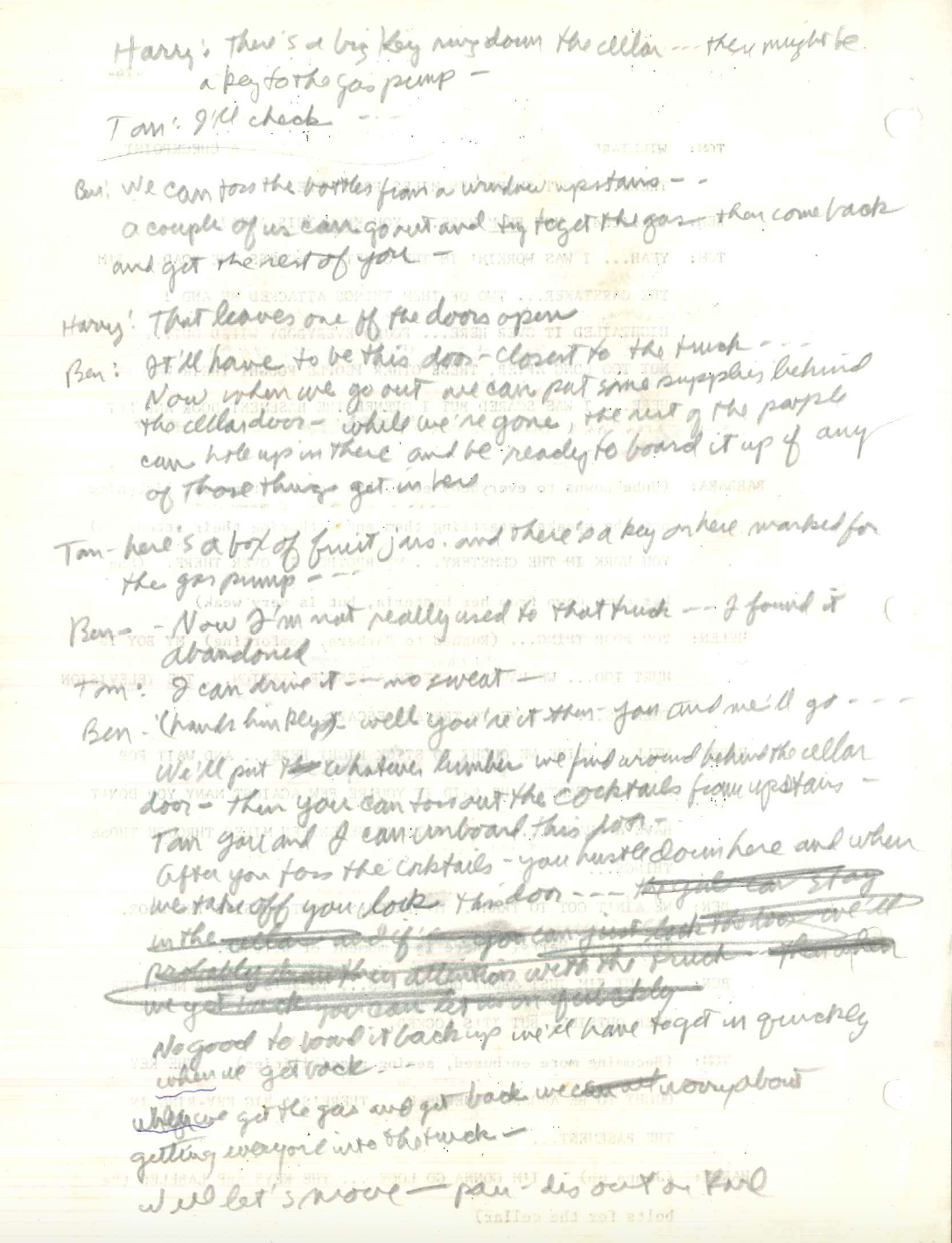
For a variety of reasons, we don't have a ton of material from the development of Night of the Living Dead. It was the first real feature-length production for everybody involved, and they were figuring out most of the logistics as they went along. We have a shooting script that is FILLED with scribbles in the margins and on the back of pages, indicating not just that many decisions were made during the actual filming, but that these decisions were sometimes major. The shooting script names Duane Jones' character Ben as "truckdriver," and all of his typed dialogue is written in a kind of stereotypical "redneck" slang ("This outta hamp their crimper..."). But the handwritten scribbles giving the character the dialogue found in the actual movie name him as either "Ben" or "Duane." And, for some reason, about 2/3 of the way through the typed script, the character's name changes from "Truckdriver" to "Ben," which suggests that there was a rewrite done of the last few scenes at some point. But the scribbles, marginalia, and new scenes written on the backs of pages tell us that most of the rewrites were done after production had begun.

As Romero's future cinematographer Michael Gornick has noted to us, when similar changes were made on the 1977 production Martin they were either written by hand or not even noted in the script. Even a decade later, Romero was not aware of the standard Hollywood practice of "pink pages" to indicate revisions. But, also, for Martin, the crew was already so overtaxed that nobody had the time to revise every single page, and the budget was stretched so thin that they didn't want to "waste" funds on printing new pages. It's reasonable to assume that, for most of the production of Night, it was easier to make changes by hand than to rewrite and re-print a new draft. 

Which is to say: this page gives us a glimpse into the decision-making process in real time from the set. Night changed the horror genre, it changed American independent filmmaking, it changed the city of Pittsburgh, which makes it seem monumental and eternal. But it was made by folks who were figuring it out as they went along.


-Adam Charles Hart

Updated:
Latent Image Christmas Card.

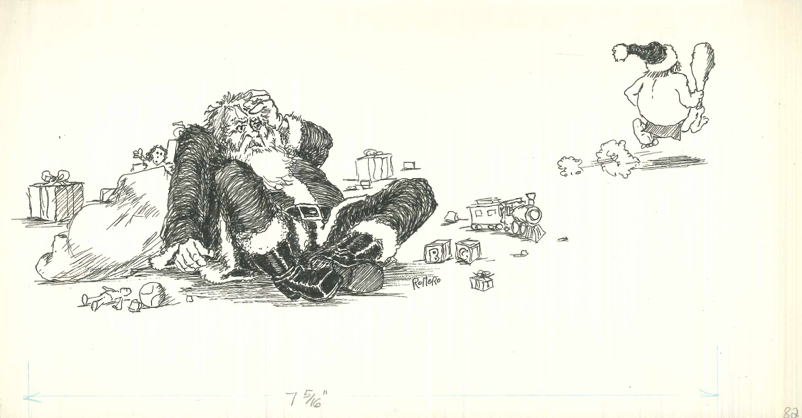
In the archive, we discovered the designs for what we believe to be the 1973 Christmas Card from the Latent Image, presumably designed and drawn by George Romero himself. The first image more or less replicates Romero's doodle of a caveman, and then the image presumably designed for the inside of the card is this, with the caveman scampering away after bonking Santa on the head and stealing his hat. 


-Adam Charles Hart

Updated:
Script pages from the 1982 draft of Day of the Dead.

One of George Romero's more beloved creations is Bub from Day of the Dead. Smart enough to learn a few basic tasks, and to grow emotionally attached to the scientist who's teaching him. The earliest materials we have for Day of the Dead were produced all the way back in 1979, when Dawn was still in theaters. That document, a very short synopsis, was likely written to secure the deal that would fund his next three films: Knightriders, Creepshow, and Day. The first longer draft comes from 1982, and it's very different from the finished film. The original conception is a huge, sprawling epic, with a giant cast of characters navigating zombie armies that have been trained to fight humanity's wars. It would have been a remarkable film, on a far grander scale than Romero would ever get the chance to work with. According to Romero's collaborators at the time, Romero could have filmed this script, but he'd need to promise an "R"-rated cut. Suspicious that fans of zombie movies would show up for a sequel that was light on gore, he instead opted to make the film with a drastically reduced budget, and that lower budget would grant him the freedom to release the film unrated. The differences between the finished film and his original conception were stark enough that he listed "Day of the Dead (version 1)" as one of his "unrealized projects" in a 1992 letter. 

There are significant differences between the synopsis, the first version, and the finished film, but some of the most fascinating elements of the early drafts are the consistencies. Rhodes, memorably played by Joseph Pilato in the finished film, is also the main villain of the first version. In the first version, however, he has actual military power, and he is more openly cruel, even bloodthirsty. But perhaps the most interesting consistency between the first and second versions of the script comes in the portrayal of fan favorite Bub, the zombie. 

In the finished film, we see Bub being taught and trained by the Dr. Logan. He shows glimmers of humanity and possible memories of simple tools and tasks, and in his progress throughout the film he seems to grow emotionally attached to Logan. In the chaos of the film's climax, Bub shoots the villainous Rhodes in vengeance for the scientist's murder, followed by a bitterly sarcastic salute. In the 1982 draft, Bub is one of several zombies to have been trained by a scientist named Mary Henried. But, whereas in the finished film Bub is the first and most successful experiment in domesticating zombies, the military dictatorship of the first version has a mass of trained zombies who perform basic tasks. Cleaning and transporting materials, mainly, but they're also trained to attack rebels and outsiders. Bub is the most advanced of Henried's students, a quick-draw sharpshooter who is loyal to his teacher and wants to impress her - their relationship in this draft seems very much like a mother-son dynamic.

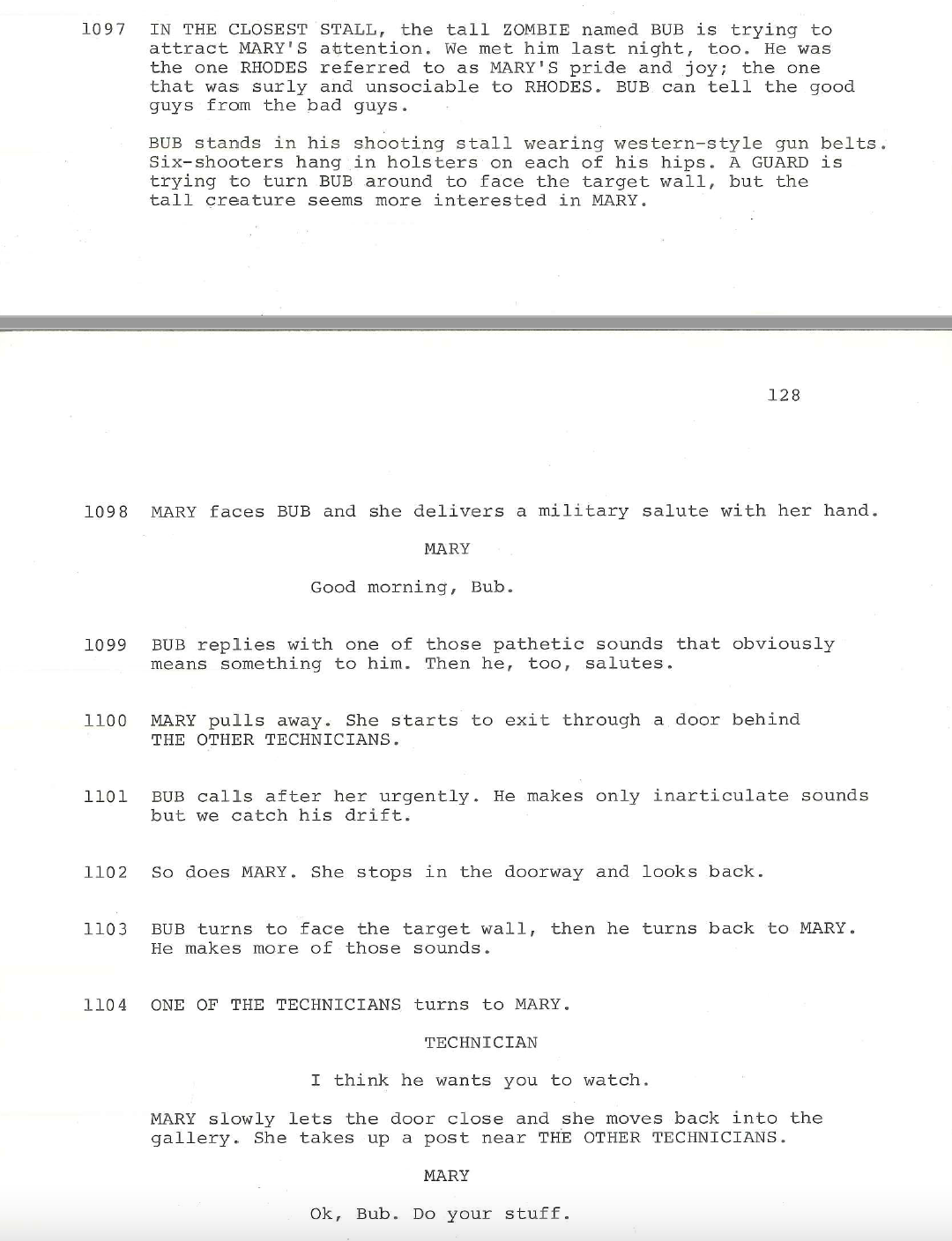
We have briefly met Bub before, alongside fellow students Bluto and Tonto, but this is his first sustained scene: 

IN THE CLOSET STALL, the tall ZOMBIE named BUB is trying to attract MARY's attention. We met him last night, too. He was the one RHODES referred to as MARY's pride and joy; the one that was surly and unsociable to RHODES. BUB can tell the good guys from the bad guys.

BUB stands in his shooting stall wearing western-style gun belts. Six-shooters hang in holsters on each of his hips. A GUARD is trying to turn BUB around to face the target wall, but the tall creature seems more interested in MARY.

MARY faces BUB and she delivers a military salute with her hand.

Mary: Good morning, Bub.

BUB replies with one of those pathetic sounds that obviously means something to him. Then he, too, salutes. 

The rest of the scene plays out with Bub continuing his attempts to please and impress Henried, showing off his prowess as a gunslingers and saluting her repeatedly, making snarling sounds as if trying to talk to her. Bub was, in both the first version and the film, Romero's first attempt to explore the "humanity" of zombies that would be so central to his subsequent zombie films and to the novel that Daniel Kraus finished after Romero's death, The Living Dead. Seeing the humanity in zombies, and attempting to, in her words, "humanize" them, is what makes Mary Henried a heroic figure in Day, and Rhodes' contempt for her efforts is one of many things that makes him a villain. 

NOTE: Many thanks to Peter Schöfböck for his assistance with this post. Peter was able to identify and decipher a cryptic memo written while Romero was in Germany, and which pertains to the reception of Dawn of the Dead in that country rather than, as I had previously assumed, to the development of Day.


-Adam Charles Hart

Updated:
Night of the Flesh Eaters promotional banners.

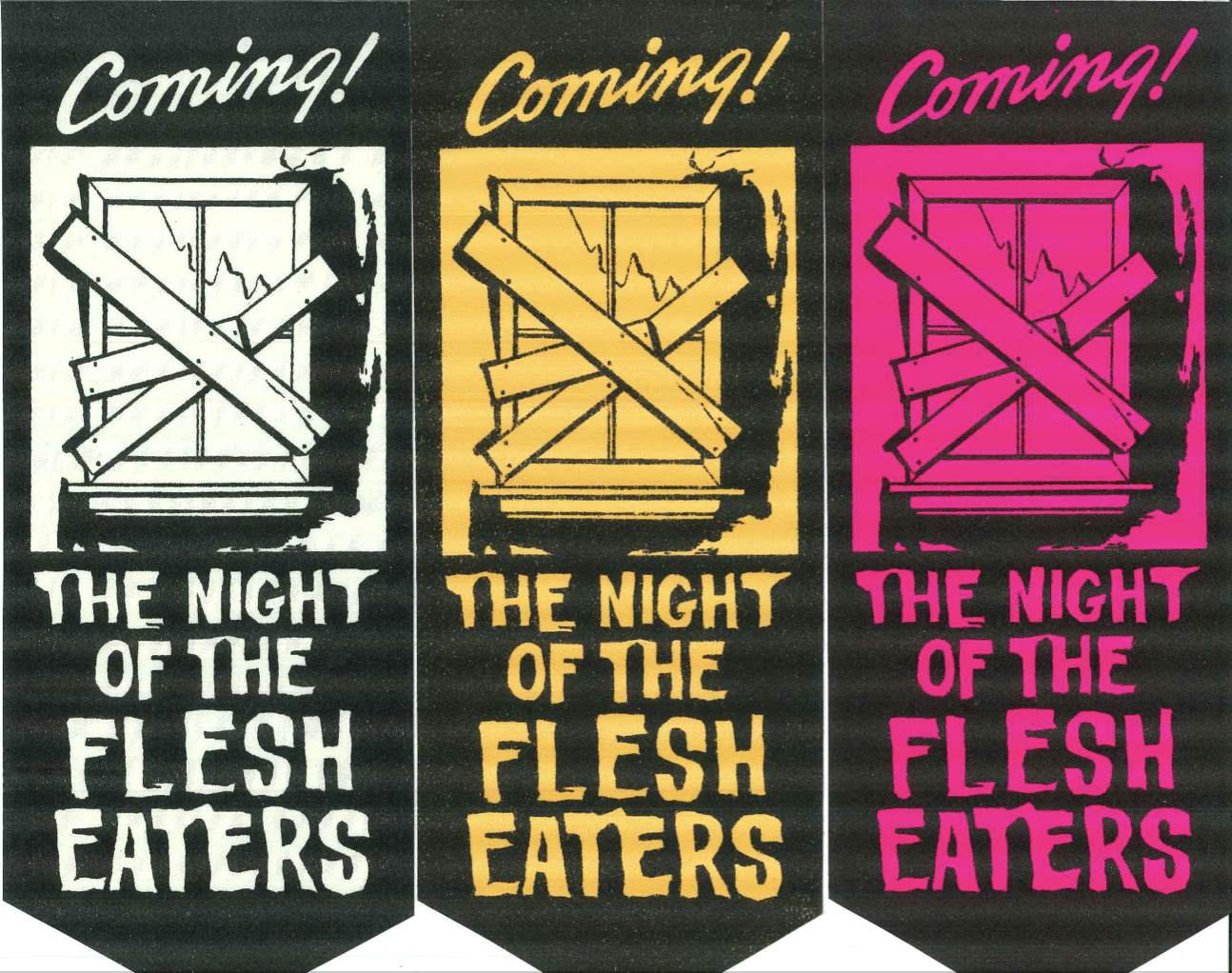
Night of the Living Dead was developed with the title Night of the Anubis, with its titled changed to Night of the Flesh Eaters during production. Famously, the distributor, the Walter Reade Organization, worried that title was too close to that of the 1964 low-budget horror movie The Flesh Eaters and changed the title to Night of the Living Dead at the last minute. In doing so, they removed the copyright notice attached to the original title and neglected to include one on the new title screen. This put the film into the public domain, which would lead to counteless screenings in cinemas and (especially) on TV in the 1970s and 1980s. The archive contains scripts and script pages referring to the film by its earlier titles, but one of the more unexpected finds were these colorful mini-banners. According to writer John A. Russo, these were produced by George Romero's father, who was a printer in New York. There were a number of them made to promote the film before it obtained a distributor, including giant banners intended to be hung outside the theater. Photos from the archive of the premiere of Night of the Living Dead at Pittsburgh's Fulton Theater indicate that this design was reused with the new title, at least for promotion in the Pittsbugh area.


-Adam Charles Hart

Updated:
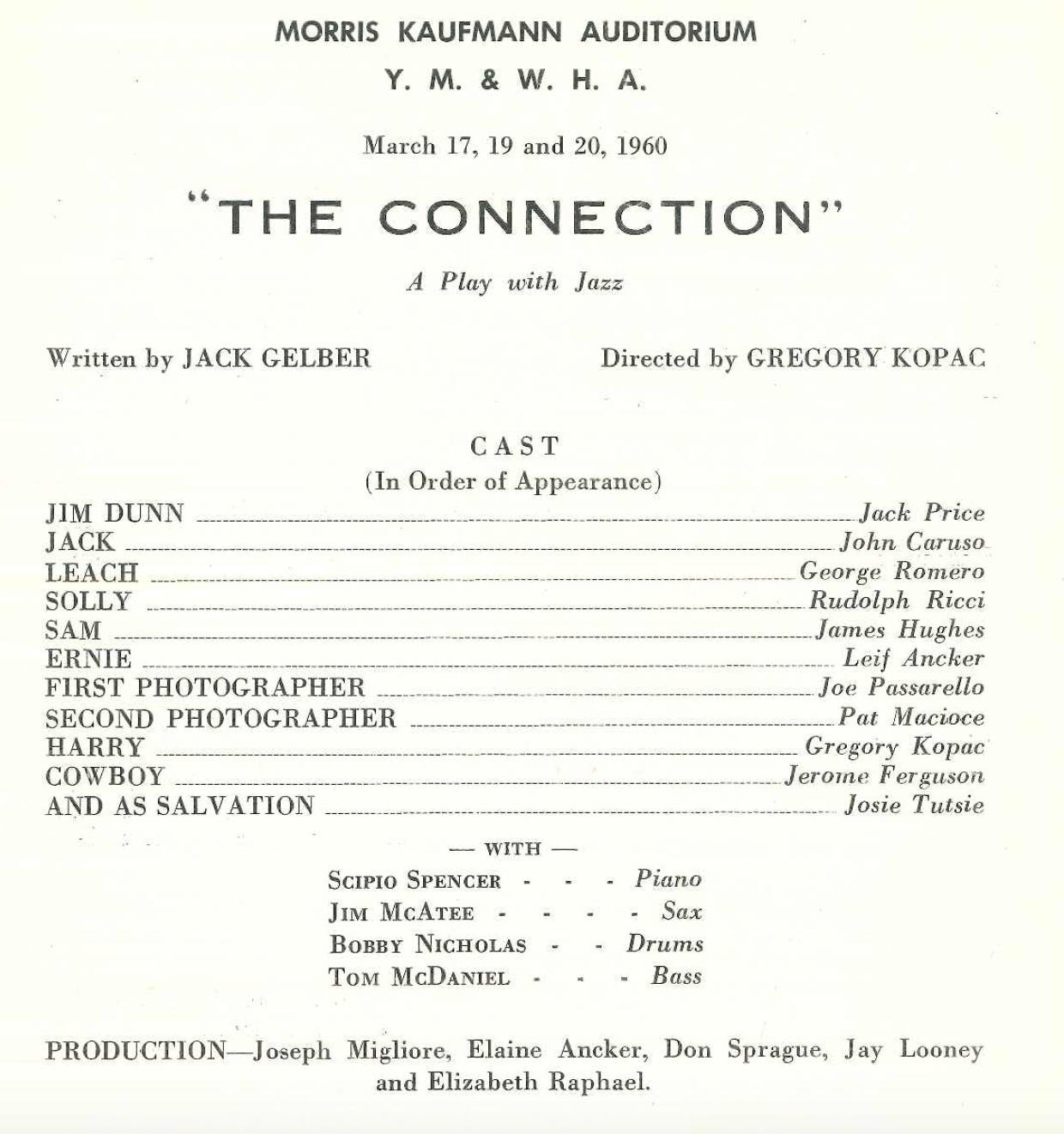
The Connection at the PGH YM&WHA.

Back in 1960, just after he turned 20 years old, George Romero had his first major role in a play, Pittsburgh's first production of Jack Gelber's controversial off-Broadway sensation The Connection. The groundbreaking "play with jazz" was about a group of beatniks and jazz musicians waiting around for their heroin connection, and it broke with all sorts of conventions of style and taste. It would become one of the foundations of the modern American theater, helping to redefine what plays could be and what they could do. This production, put on at the Young Men & Women's Hebrew Assocation auditorium March 17, 19, and 20, 1960, cast Romero, he later claimed, "because I was large, my only impressive quality." Also in the cast was later longtime collaborator Rudolph Ricci. Romero played Leach, the owner of the rundown loft in which all of the action took place. At the end of the play, his character overdoses, which required Romero to use a needle and some skin-colored putty to inject himself. In 1959, the legendary Living Theater's production in NYC had brought the avant-garde theater to some level of fame among hipsters and intellectuals around the country. The Pittsburgh production premiered less than a year later, so it would have been one of the first productions anywhere outside of New York.

In a speech written later in his life, Romero recalls the revelation he felt on stage: 

"We played five performances, and each time, when I shot a needle into the silly-putty on my arm, the audience gasped. They gasped! I had the power to Make them gasp! I was hooked. I had to find a way to make audiences gasp again. But how? I'd never even had a thought about a career in the theater, or in film. I figured you'd never be allowed in, unless you were some sort of 'Born Royalty.'"

At the time, Romero was a self-confessed poor student training to be an artist at Carnegie Tech (now Carnegie Mellon). In the audience for one the play's performances was the head of the Fine Arts department, Ted Hoffmann. Hoffmann, a drama teacher, was impressed by his performance and suggested Romero change his major to drama. Or, in Romero's account, he told him, "George, you're a much better actor than you are a painter." Romero agreed and became a drama student. He would never get enough credits to graduate in his new major, though he did have a small role in a student production that also featured Carnegie Tech student and future Star Trek: The Next Generation actor Rene Auberjenois. Instead, he and other young actors, drama students, and others working in andaround the theater in Pittsburgh soon began developing a more active interest in the movies. 

Romero didn't save much from his artistic career pre-Night of the Living Dead, but in the Pitt Libraries theater archives we happen to have a single archive of the YM&WHA. Of that most of the playbills and other materials are from the 1930s and 1940s, when public funding created a theater renaissance. We happen to have one playbill from the era, and it's of The Connection

One early biography of Romero, created along with promotional material for Night of the Living Dead, mentions not just The Connection but another landmark work of avant-garde theater in which Romero appeared in Pittsburgh: Jean Genet's The Balcony. In my research, I've found absolutely no mention in the Pitt theater archives, in searches of newspapers and magazines, or google, for that matter, of any production of The Balcony in Pittsburgh in the 1960s, let alone one that featured Romero. 


-Adam Charles Hart