While best known for his horror films, reading through his unproduced writings, it is apparent that Romero was a dedicated fan of science fiction. Many of his writings reflect a deep fandom of not just the genre, but also reflect an interest in space that many of his generation shared growing up during the dawn of the space age and the advent of artificial satellites and human space exploration.
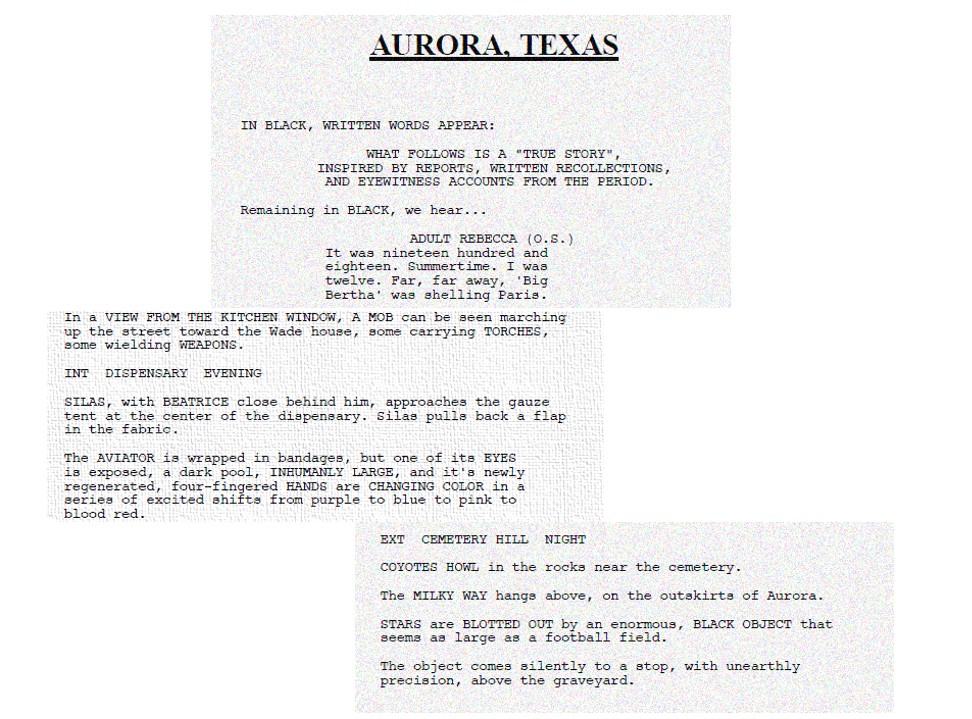
One of my favorite science fiction inspired script is for the unproduced project Aurora. We don’t have much information about the project other than a single draft script, but it appears to have been written in the early 2000s. The story follows the aftermath of a UFO crash in a small town and the reactions of the townspeople.
The story opens with a narrator recounting an event that happened during her childhood, in 1918 in the small town of Aurora, Texas. The town is under quarantine, and so far, safe from the flu pandemic ravaging the globe. While feeling mostly safe cut off from the world, the townspeople fear the Germans using planes or zeppelins to drop the virus onto their town. There is also an underlying fear of Martian craft visiting earth (and perhaps working with the Germans or the US government toward some nefarious means). It is with this mindset they start to react when something crashes into an oil works on the outskirts of town. Pieces of an unknown craft are found, and rumor has it one of the townspeople has saved and is harboring the pilot which may be an alien. Add to this a mysterious sickness that is quickly making its way through the town and the paranoia and fear ratchet up even more leading to a tense narrative throughout.
Our main protagonist (and father to the narrator) is a disgraced local doctor and town drunk. The main townsfolk distrust him and have largely ostracized him, but he continues to practice medicine and provide for other denizens on the margins of the town, namely the indigent who can’t pay for care and the people of color who are excluded from care. He is a proud man who refuses to let the treatment by the townspeople break his spirit. He goes to the site of the crash and rescues the pilot and brings him to his barn to treat it.
From here, we see the main conflict of the story begin to unfold. The doctor and his family (particularly his young son) want to treat the pilot regardless of whether he might be an alien or not and recognize the need to keep him safe from the townspeople (the son is excited about the prospect of the spaceman – alien or not – as he has recently discovered the works of Wells and Verne). The owner of the oil works is our main antagonist: a rich mogul who not only controls the oil, but also the food in town and never hesitates to wield his power and influence over others. He despises the doctor and helps lead the townspeople into a mob. A sickness is also starting to make its way through town, further adding to the townspeople’s’ paranoia and anger as they blame the doctor for its origin. Ultimately, the doctor cannot save the pilot but learns that the sickness was caused by bad meat that the mogul knowingly sold in order to not lose revenue. The mothership arrives to pick up the body of the alien and we find out the doctor swore off alcohol and had his medical license and reputation restored.
The location and seed of the story come from a purportedly real incident that took place in the town of Aurora, Texas in 1897 – a full 50 years before the famous Roswell Incident; and significantly, before the advent of human flight. The incident remains a notable entry within American UFO lore (indeed, Texas writer Joe R. Lansdale references the incident in one of his novels). Even as recently as September of 2021, the local news wrote about the enduring impact of the crash and the burial of ‘Ned’ the alien. A small roadside attraction exists, and folks can visit the gravesite of Ned (the name affectionately given to the supposed alien visitor). He was given a Christian burial so the remains cannot be exhumed for modern forensic examination.
Romero shifted the story forward two decades to take place at the end of World War I and as the 1919 Flu Epidemic is ravaging the globe. He utilizes this new timeline to effectively exploit the fear and paranoia that went on during not only a global pandemic, but also over fears over the impacts of the early days of human flight had upon the expansion of war.
We can also see influences of major science fiction works on the script, most notably War of the Worlds and The Twilight Zone. The behavior of the townspeople is reminiscent of the classic episode “The Monsters are Due on Maple Street” in which a neighborhood descends into fear, paranoia, and violence over the potential of alien invaders after something flies over the neighborhood and causes a blackout. Of course, Serling himself was only drawing upon the experiences of the Cold War for his story. Romero likely also drew upon his own memories of the Cold War; or even reflected on the similar atmosphere of fear, paranoia, and brimming violence that characterized the post-9/11 mindset in the US.
Ultimately, Aurora finds itself among the over 100 scripts that never made it any farther than the page. It is a shame as the story unfolds with great pacing, sympathetic characters, and a healthy dose of his ever present and prescient social commentary. It is also a demonstration of his fandom of science fiction and his fascination with space and the potential existence of alien life and UFOs.
--Ben Rubin