Articles

Updated:
Cobras and Cults: Wes Craven's unproduced Twilight Adventure

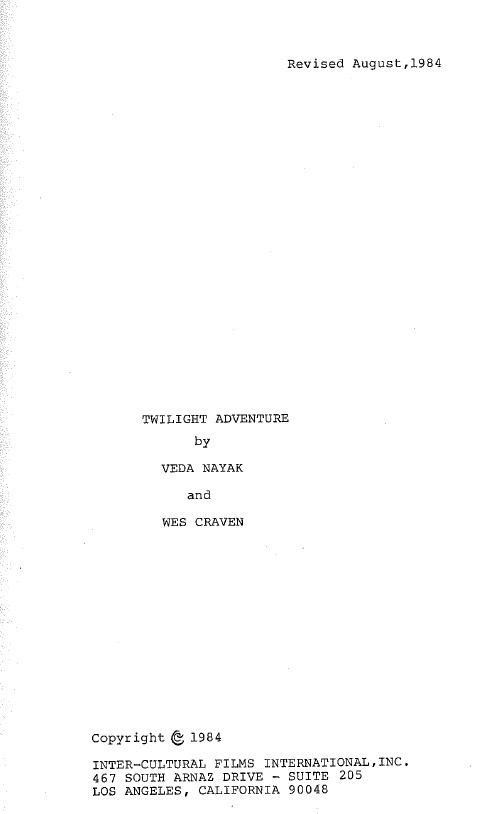
In 1984, while finishing edits and filming A Nightmare on Elm Street, Wes Craven was also working on a script titled Twilight Adventure.  The script was co-authored with Vada Nayak and a revised script from August 1984 now sits within our Horror Studies Collections.  Some cursory research does not turn up any information about this project, so it’s unclear how serious the project was or if it made it past the script writing stage.  But let’s explore this rare and unproduced script here.  

The plot unfolds over the course of a few days with some flashback scenes to establish background information and conforms more to the elements of a thriller than a horror film.  The general story revolves around the death of a patriarch, the conflict of succession of his estate, and a long-held family secret.  Of course, things are not quite so straightforward as a supernatural element is also present with spells, black magic, and a secretive snake cult.   

The story begins from the point of view of a snake entering an encampment, slithering into a house, and rearing up to bite the inhabitants (we see it’s shadow cast by lamplight and see the trademark hood of the cobra); quickly move to a cavern with a snake idol and acolytes in snakehead hooded robes worshipping (the attire mimics the cobra hood); and finally a winery plantation with the longtime crew foreman warning the estate owner about the curse of the serpent; the skeptical owner is fatally bitten by the serpent moments later, setting into motion the main plot of the film.   

Justin Strong, the son of the plantation owner, is a professor working in Switzerland.  He is notified of his father’s death and quickly makes plans to fly back to the estate to deal with the funeral and his inheritance.  Declining sales and no real interest in overseeing the family business, Justin is interested in selling the estate.  We eventually find out that the grounds contain a hidden treasure which is protected by magic enchantments to keep it safe from a cult that worships the serpent.  Several more deaths occur; we find out the Rasputin like shaman character that has enthralled the family matriarch is really the villain using his connection to discover the secret to access the treasure; the son eventually learns the truth to his family’s fortune and success; and then the climatic battle.  Through superior firepower and a powerful amulet, the son prevails but destroys the treasure as it was enough opium to overdose the entire world.   

Overall, the script is fun and certainly action packed.  The final third in which the showdown occurs would have been a fast moving and impressive sequence that surely would have excited an audience.  But the script is also clearly still in early stages needing further revisions to develop some of the plot elements.  Regardless, it provides a interesting look into a Craven film that could have been and one might even see the interest in black magic and indigenous customs and rituals that he would revisit in The Serpent and the Rainbow.   

 A couple of notable observations:  

-The setting, both in time and place, seem a bit strange: the story is set in the ‘Balkans’, with the only other description being overlooking the Adriatic. This should place it in then Yugoslavia or Albania.  However, nothing else in the story really matches up with this setting.  Additionally, the descriptions of the estate and manor seem as if they would fit in more with a pastoral and perhaps 19th Century period.  And lastly, while certainly the aesthetic of a cobra is enticing, the complete lack of any question about a non-indigenous snake preying on the vineyards just seems out of place.   

-There is a certain feel to the script, particular a scene set in a bazaar and the final climactic scene in a series of caves, that feels very much as if it was inspired by Raiders of the Lost Ark.  Additionally, there is an underdeveloped Nazi plot line that similarly feels inspired by Raiders.  The symbol of the snake cult is serpents in the shape of a swastika and there is a reference to the treasure having been hidden by Nazis, but the plot point is left undeveloped and unclear.    

-There is a hilarious scene reminiscent of a Looney Tunes cartoon.  The main character finds himself walking in open air, but falls when he looks down and realizes there is nothing beneath his feet.  Of course if he hadn’t looked down, he would have been fine.  One can see the same fate befalling Wyle E. Coyote or Daffy Duck.   

-The climatic battle scene reads like an action packed thrill that could have fit in with and stood up along side many other films from the 80s.   

-Ben Rubin
Updated:
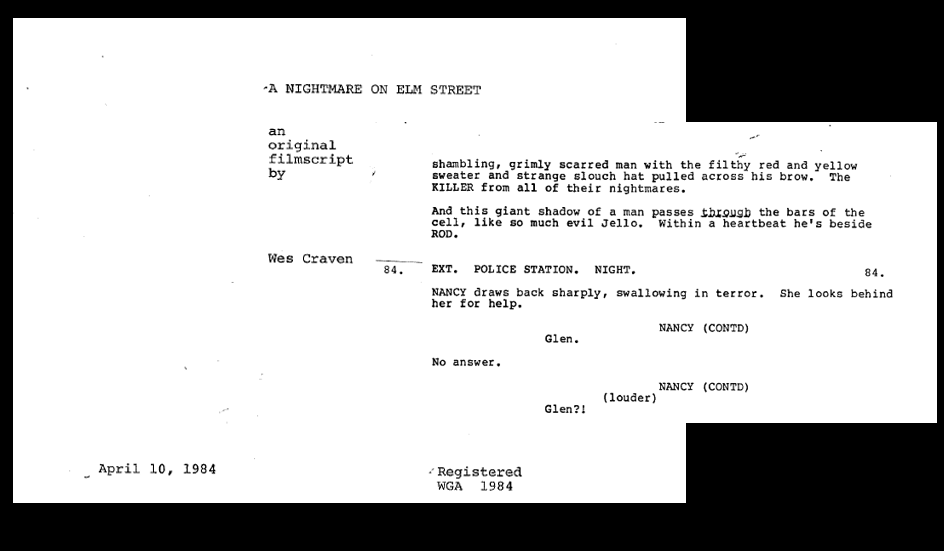
Guest Post: Observations of A Nightmare on Elm Street draft script image

Editor's Note: The following guest post was written by Mackenzie Morehouse, a local high school student completing an internship with Archives & Special Collections focusing on working with the Horror Studies Collections.  We are very proud to showcase her fantastic essay here examining a draft script of A Nightmare on Elm Street (1984). – Ben Rubin

In a widely-circulated review of the recent Saw film Spiral (directed by Darren Lynn Bousman) earlier this year, New York Post reviewer Johnny Oleksinski directly compared the decades-long Saw franchise to older works in the genre. “Where George A. Romero was trying to reflect social ills in ‘Night of the Living Dead,’” Oleksinski wrote, “‘Saw’ was putting Porky in a blender.”[i] In 2019, Dennis Widmyer described his remake of Pet Sematary as “elevated horror” in a South by Southwest festival panel. Despite Jordan Peele’s assertion that his recent film Us was a horror film, reviewers made sure to clarify that it was not like other horror films; Richard Brody’s glowing New Yorker review explained that calling it horror was “like offering a reminder that ‘The Godfather’ is a gangster film or that ‘2001: A Space Odyssey’ is science fiction.”[ii] Nevermind that they are, despite cinematic achievement, just as a good horror movie cannot be separated from horror, regardless of what merit is perceived.

It is with this recent societal shift in the perception of horror movies as films which used to be schlocky and meaningless, and are now sharp and intellectual, that I first came to the original screenplay of Wes Craven’s A Nightmare on Elm Street[iii]. Elm Street is a pop culture fixture which has been parodied uncountable times---the infamous image of Freddy’s gloved hand leering up at us from between Nancy’s legs continues to stick in our collective cultural consciousness like the memory of a dream. There are certain scenes which even now are surprisingly brutal, especially from a franchise that would eventually give in to a very trademark kind of camp silliness. I knew going in that Elm Street holds up as a horror movie, but does it hold up under the new-age scrutiny of “elevated horror”?

Notable moments from my first reading of the screenplay:

  1. After Nancy is attacked at the sleep clinic, her hair turns completely white from shock, instead of just the streak of white she is given in the film.  This was written to happen right before our eyes, so it makes sense that it couldn’t make it to the final draft, though it would have been a cool visual effect.
  2. Excerpt from page 41: “[A]nd this giant shadow of a man passes through the bars of the cell, like so much evil Jello.”
  3. Freddy Krueger is a pedophile, something made extremely clear by both the original film and the subsequent sequels, and it’s not unusual for his attacks to take on the appearance of coded sexuality (see the bathtub scene, which I referred to earlier), but it reads as much more glaringly obvious in the screenplay. All this writhing around with young girls in or near beds, the physical closeness required for Freddy’s preferred method of killing, the tearing of the clothing---hell, Tina was killed by him while they were both under the sheets. Elm Street is far from the only slasher of its era to code its attacks on female victims as sexual in nature, but I find the method used in this movie more interesting and self-aware than some of its peers; it shows more than anything the overwhelming silence which surrounds sexual victimization. No one helps or listens to Nancy even as she repeatedly warns the adults in the community about what happened to her friend, what is happening to her, what she fears will happen to more children of Elm Street. By targeting teenagers specifically, Freddy keeps them isolated from the society that surrounds them, and in this way A Nightmare on Elm Street in any other genre would become a story about the need for open dialogue on sexual assault and the importance of forming survivor communities. In horror, it becomes a story about reconciling who you are with the actions and trauma of the most widespread villains of all: your parents.

The oldest horror story of all time is the one between mother and daughter. In Toni Morrison’s Beloved, a mother is haunted by the infant daughter that she drowned in order to protect her from the horror of slavery. We can go back further. In the screenplay, Nancy is compared to the Greek Cassandra, blind prophetess who was never believed; child killed by her rapist’s wife, Clytemnestra, a twisted reflection of the maternal figure, who believed her just fine. When I watched A Nightmare on Elm Street for the first time, the mother-daughter tension lingered for the most part in the background, out of sight of the cameras. There was so much else going on---dream demons and teenage slaughter and pills being used way above their recommended dosage. But behind the man-eating beds is another fear, just as potent: where is the line between protecting and harming our children?

MARGE smiles, relieved. The girl pulls the blanket around her shoulders. Her eyes flutter closed, her breathing becomes regular and deep. Once again she’s the little girl MARGE fantasizes she is.

Page 79, white edition (1984)

Marge wants to protect her child, who is facing a threat she understands to be real; in one draft of the screenplay, Marge herself is the one who doles out Freddy’s fatal blow when he attempts to escape the burning house; but it isn’t really Nancy she’s thinking about, it’s a version of Nancy which no longer exists. In doing so, she leads the current version of her daughter straight into the belly of the beast. Marge’s protection of Nancy is just as much maternal instinct as it is a retroactive protection of herself from having to see who she has become: an alcoholic who inprisons her daughter in her own room. She tries to unlive an act she knows was unforgivable by inadvertently giving it to Nancy, and in this way the guilt of the parents of Elm Street acts as a parasitic force throughout the film.

MARGE (CONTD)

(drunk satisfaction)

Paid the guy damn good to make sure you stayed put. You ain’t goin’ nowhere, kid. You’re gonna sleep tonight if it kills me.

Page 85, white edition

A Nightmare on Elm Street is, first and foremost, a slasher. But does that make it devoid of meaning? Horror has, historically, been viewed as a low-brow genre, often on par with pornography, but there has always been an emotional core to latch onto, no matter how bloody the picture. When Marge and Nancy’s relationship is what propels much of the plot, I don’t think it is something that can or should be ignored as part of the greatness that is Elm Street. Does that make Elm Street elevated horror? No. I don’t think anything is, really. Horror is interesting enough without needing pretentious labels, and that includes all kinds of horror. If any of this means anything at all, it’s that Wes Craven’s A Nightmare on Elm Street is a damn good watch, and possibly an even better read.

[i] Oleksinski, Johnny. “ ‘SPIRAL’ Signals the Death of ‘Torture Porn’ – Good Riddance!”. New York Post, May 13, 2021.

[ii] Brody, Richard. “Review: Jordan Peele’s “US” is a Colossal Cinematic Achievement”. New Yorker, March 23, 2019.

[iii] Craven, Wes “A Nightmare on Elm Street” draft script, April 10, 1984.  University of Pittsburgh Library System Archives & Special Collections.

Updated:
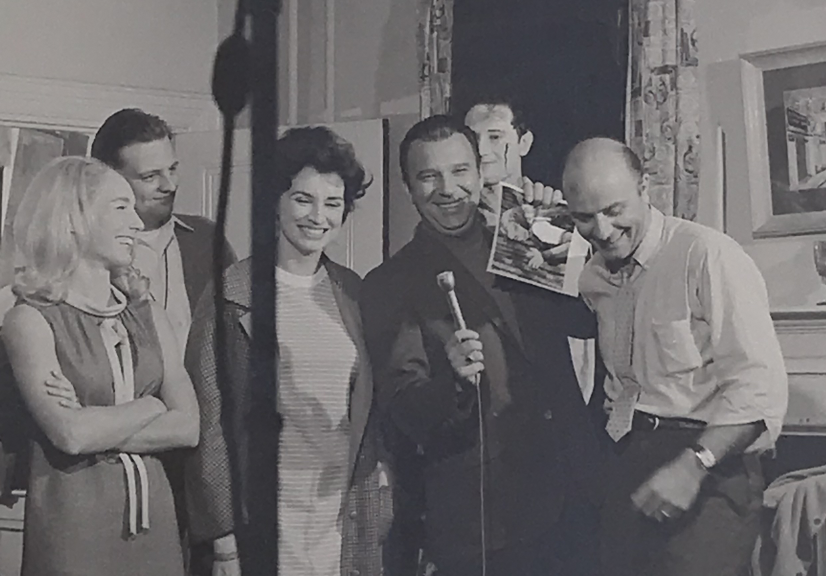
On the set of Night of the Living Dead.

Marilyn Eastman, one of the stars of Night of the Living Dead, has passed away at the age of 87. Before her roles in front of and behind the camera for Night, Eastman was, along with her real-life/screen husband Karl Hardman, a prominent performer on Pittsburgh radio. That local celebrity led to this delightful early report of Night's production, in the Pittsburgh Post-Gazette, focusing on the best-known figures involved in the movie: 

It was very easy for Karl Kardman [sic] and Marilyn Eastman to show "abject terror," which was what cinematographer George Romero asked them to show, for a scene the other day in "Night of the Flesheaters," the full-length movie they're shooting here. "As a matter of fact, after lying around in front of an open window for two hours, both of us all covered with prop blood and plastic gore," Mr. Hardman later observerd, "I think it would have been difficult for us to muster a smile even for Jean Paul Getty's Welcome Wagon."

The archive contains a number of behind-the-scenes photos from the production of Night, all of which reveal a truly collaborative effort, in which everyone always seemed to be doing something to help. Making an independent movie with a bare bones crew and a severely limited budget required hard work from everybody involved in it, and it took a very long time. And yet, as hectic, as difficult, as grueling as the shoot could be, the pictures also seem to reveal a sincere sense of enjoyment and excitement in the cast. This photograph attached here is one of my favorites, from a day when "Chilly Billy" Cardille visited the set. In the photo are actors Judith O'Day, Eastman, and Hardman standing next to Cardille, with Romero and a zombified John Russo just behind him. Cardille is holding up a photo of one of actress Judith Ridley, who evidently couldn't make it to the group photo in person. This photo would have been taken months before the film was completed or released, and long, long before the film became a sensation on the drive-in circuit or a ubiquitous cultural landmark. It was, at this point, a labor of love that had required weeks and months of work from all involved, and they all look thrilled.


- Adam Charles Hart

Updated:
George A. Romero's The Golem

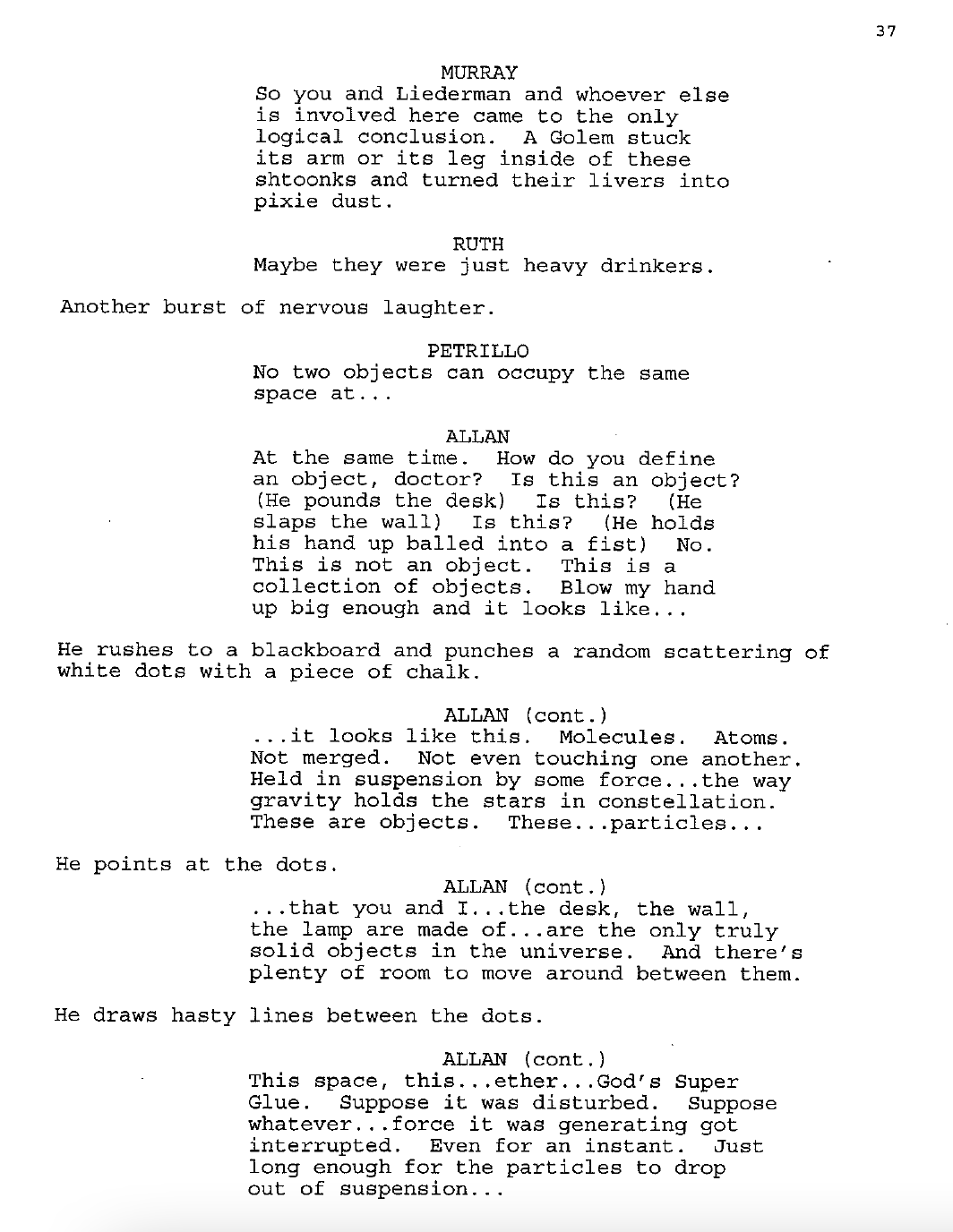
In 1995, George Romero wrote The Golem, a screenplay that radically re-imagined the golem myth - a myth that would continue to be important to his thinking about science, technology, and society: the monster that turns on those who create it. Many of the themes would, for example, re-appear in the Resident Evil scripts he'd write in the next two years. (Romero's final completed work would be a collaboration with artist and longtime friend George Nama called "The Liberator," for which Romero contributed an acidic short story about a modern-day golem.) He set the story in contemporary America, where a secret military/intelligence organization discovers that an elderly Jewish man is protected by a golem. They kill him and begin work to create their own unstoppable clay killing force. With the immense resources and teams of brilliant scientists at their disposal, they succeed very quickly! However, although they deduce the proper procedures for creating a golem, they have failed to reckon with the moral or mystical elements of the creature. Summoning a golem requires the summoner to be morally upstanding and for their cause to be just: you cannot use a golem for personal gain, for vengeance, for cruelty, or, for power. The military, of course, does not intend to restrain themselve. This golem is conjured to be an enforcer, as a weapon of war, which proves to be deadly for everyone involved in the conjuring. The military’s compulsion to weaponize the sacred dooms them all, as the creature instantly turns on its creators. They turn an endless barrage of high tech weaponry on it to no avail. Bullets, bombs, fire, and ice all break down the golem’s body but fail to destroy it, the creature reconstituting itself over and over again. 

The creature is summoned through cutting-edge digital computing. Sarah, a military scientist explains:

There are twenty-two letters in the Hebrew alphabet. Each of these also represents a number, ranging from one to four hundred. Each of these numbers is said to  contain a message in what we call ‘gematria.’ […] Kabbalists believe that these letters, arranged in pairs, in every possible permutation, are the … ‘Gates of Light’ … […] the whole of God’s knowledge passed down to us in the Torah. […] The secrets of the universe. The secrets of creation itself. The numerical infrastructure of the cosmos… are contained… theoretically… in this alphabet.

They have computed the number of possible sequences at 236,789,665,204,633,600,000, and, using their “HP LASER JET PRINTER” they will print every one of them out to place inside the chest of a clay sculpture. The proper sequence will necessarily be contained within them, allowing the military to wield “the secrets of creation itself” without ever determining which sequence invokes that magic power, gained by the sheer volume of their digital firepower.

Or, at least, that’s half the equation. That sequence of letters “gives it its power. It’s [sic] potential. The shem gives it its life.” The military needs to invoke “the secret Name… of God” in order to activate their unstoppable soldier, which they do through an amulet. The creature is fundamentally a mixture of cutting edge digital technology and pre-technological superstition, of computers and clay. And it could only be realized on screen with CGI. Romero’s version of the Golem is a kind of amorphous blob: it begins as a large clay statue in the shape of a man, but constantly evolves and re-forms, capable of taking on the form and nature of anything it comes in contact with, slinking through shadows and merging with columns, weapons, even living things:

We realize that Chino is in distress. He gags. Chokes. Striker turns and sees him TREMBLING. With great effort, he pushes with his hands. His head comes away from the column TRAILING A THICK ELASTIC STRAND OF MATTER. […] Chino’s body is YANKED against the column, as though on a giant rubber band. He his FLAT, his arms and legs splayed out. He seems to GET LARGER… INFLATING… not radically… rather like a balloon getting its first breath of air before the rubber stretches.

In the next moment, THE GOLEM APPEARS… walking OUT OF THE COLUMN… walking OUT OF CHINO… walking THROUGH CHINO.

Training an arsenal at it does little, as any kind of physical attack simply breaks it down to component parts that then recombine in another form – which is, not coincidentally, the nature of its own attacks. It is not simply that the Golem clobbers its victims with its superior size and strength, but that it kills by attacking at the molecular level. It is, in other words, fundamentally digital, an accumulation of modular information with the capacity to reduce everything around it to its own modular building blocks.

It operates with the cold, inhuman logic of a machine, but still adheres to an older, sacred morality:

The Golem will kill mercilessly, but it will not kill in anger or revenge. It kills only to protect its tribe or to… or to punish its maker if… if that maker does… evil… in the eyes of God.

And, of course, creating a Golem to be an aggressive military weapon is inherently sinful. Each member of the organization who helped create the Golem instantly becomes its target. The action unfolds in combat against the creature, and, in the end, after all conventional weapons have failed, the handful of survivors seemingly defeat it through magical/sacred means: writing the name of God backwards, in Ugarit rather than Hebrew.

However, this being a Romero script, the resolution is not without ambiguity or ambivalence. The only way to definitively defeat a Golem is for the conjurors – all of the conjurors – to die. Carving the proper Ugarit characters into the surface of the Golem seemingly defeats it but the survivors realize that it isn’t dead and it isn’t gone, just “turned off.” But they know that one character had been spared by it after throwing herself in front of it in an attempt to distract the Golem and save others. She had earned survival through selflessness and sacrifice. In the moral logic of the script, bringing a Golem to life can only end in one of two ways: the death of the creators, or a life of upstanding moral purity. One of the characters is an innocent, a “fool” with a likely learning disability who, we discover, had himself conjured a Golem – “Big Abe” – when he was younger. Because of Thomas’ (not unproblematic!) moral “innocence” means that he is not in danger. Big Abe, in fact, continues to serve as his protector. The film ends with one of the survivors, a native American named Benjamine Tall Tree (a name repurposed from Jacaranda Joe) asking Thomas to be his teacher.

The Golem, like the T-Virus of Resident Evil, cannot be put back into the box once it has been freed. In Resident Evil, as in most of Romero’s zombie scripts, the outbreak can be controlled if humanity can simply work together for the common good, if greed and shortsighted personal gain and petty interpersonal grievances can be overcome. In The Golem, that is policed directly by an enforcer of God’s own moral code. The survivors have to live with the uncertainty of never knowing whether or not a transgression might prompt their revived executioner to strike. It is the Platonic ideal of a Romero scenario: survival is possible, but only if you are selfless. What marks The Golem’s resolution as unusually optimistic for Romero is that the script seems to entertain survival as a very real possibility.


- Adam Charles Hart

Updated:
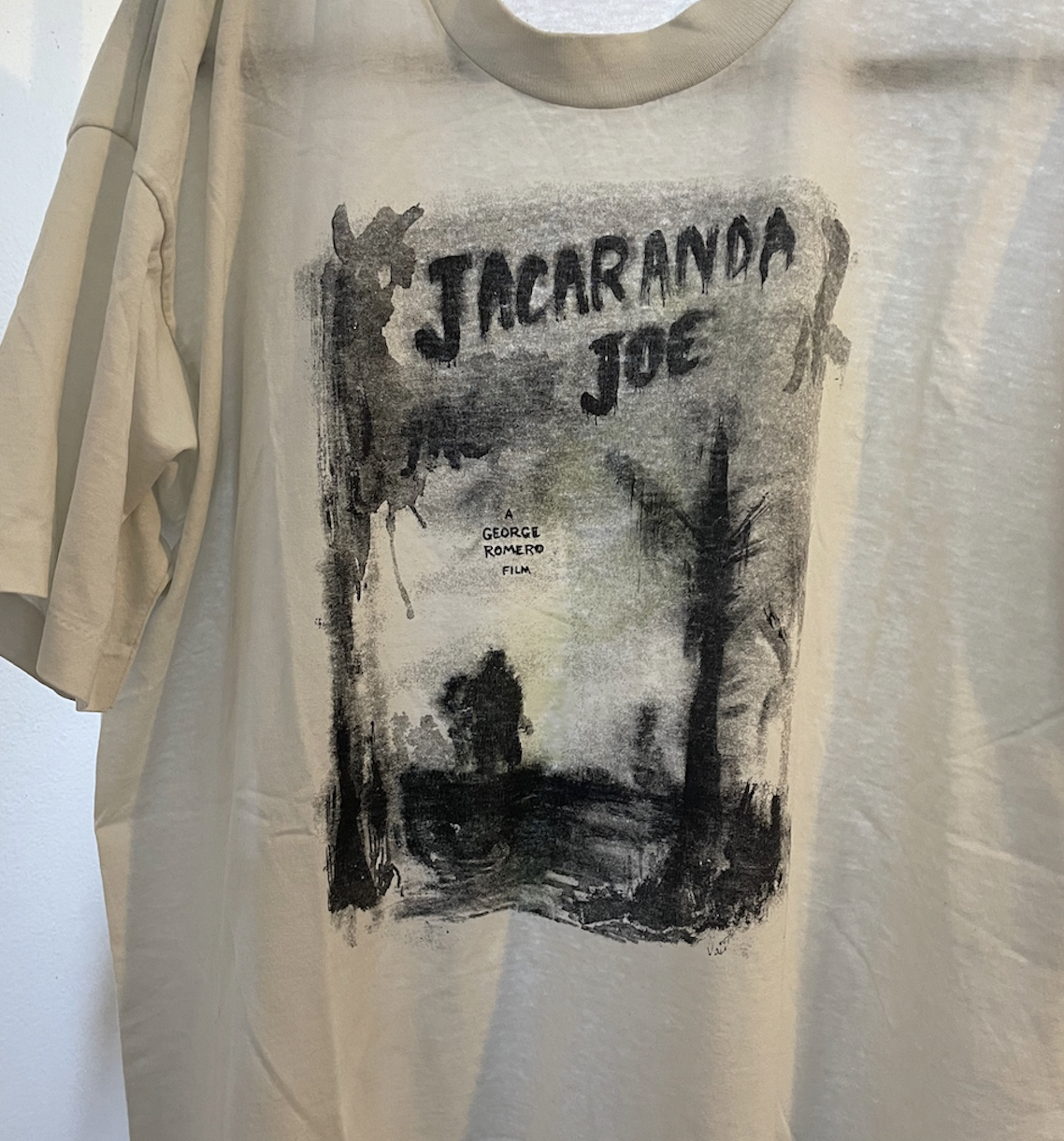
Jacaranda Joe crew t-shirt.

I've been speaking to crew members who worked on George A. Romero's Jacaranda Joe and will have a more substantial update soon, but, briefly, the film was the second installment of an innovative program devised by Valencia Community College faculty member Ralph Clemente that brough established filmmakers to campus to direct a short film. The previous year, Robert Wise (director of The Haunting, West Side Story, and The Sound of Music), filmed a short called Best Two of Three with Valencia studentsJacaranda Joe was written by Romero with the scope (and limitations) of filming in ten days in central Florida with a student crew in mind. Romero picked up an idea he had first developed two decades earlier, about a tv show that stumbles across a bigfoot society in the woods. Romero transposed this from the woods to the Florida swamps, reduced the bigfoot community to a single "skunk ape" creature, and built the majority of the narrative around a sleazy talk show host's discussion of the brief glimpse of the creature that had come to be known as "Jacaranda Joe." That meant that most of the shoot would take place on a single set. Joe himself only appeared in a single, blurry shot, which meant that while a full creature needed to be designed and executed, it could be relatively simple compared to a monster that needed to be on camera for long stretches of a movie. 

There was discussion of Romero returning to continue the rest of the story the following year, but there's no indication that he ever wrote anything else or did any concrete work to develop the project beyond his time at Valencia. Beyond Romero's own interest or other projects (most pressingly Before I Wake) that began to take up his focus, there were basic logistical difficulties to continuing the short film. For one thing, other than Clemente and Joe director of photography Dominic Palmieri, none of the crew would be returning. He'd need to start over, work with a different Assistant Director and Art Director and different Editors and Sound Recordists. Valencia was a two-year school, but the filmmaking program did not begin until a student's second year. So every one of the 40-ish students who were in the filmmaking program graduated shortly after Romero finished shooting in June 1994. The editors who continued working on the film - George Rizkallah (referred to as "Little George" on set bc of his relative height compared to the 6'4" Romero) and Bobby Gibis, both of whom have had long and productive careers in film and TV - did so out of dedication to the project, but the vast majority of the crew were no longer even in the area. 

Jacaranda Joe was shot in the awkward transition between film-only shooting and fully digital filmmaking. All in-studio filming was done on 35mm, while exteriors were meant to mimic local news and TV and so were done entirely on video. The 35mm was transferred to video to be edited on a state-of-the-art AVID system, which meant a substantial loss of image resolution. So, the goal was to eventually cut the film on film - a step that was never reached in the post-production process. At this point, digital editing was essentially a way of creating a rough cut to guide the physical cutting of the film prints. There were at least two cuts of the film completed by Rizkallah and Gibis, but titles and credits were never added. So the cuts of the film that were exported to VHS or the digital video formats of 1994 are the only copies of the edited film that had ever existed.

All of this means that there never would have been a public screening of Jacaranda Joe, as the cuts were completed well after graduation, so most of the people who'd have wanted to see the film would no longer have been at the school, and the only copies of the film to be created were on video transfers that were too low-resolution to be projected.

More interviews and research and potential discoveries will be coming soon, but I'm writing now in part bc both Rizkallah and First Assistant Director Michael Sellers have dug out some amazing materials from the shoot, including the crew t-shirt. The archive does not, alas, have a Jacaranda Joe t-shirt of its own, but I think we can all admire just how AMAZING it looks. HUGE thanks to Rizkallah and Sellers for their assistance and for sharing their recollections with me. 


- Adam Charles Hart