Articles

Updated:
The "First Draft Treatment" of Dawn of the Dead.

The earliest material for Dawn of the Dead seems to come from 1974, possibly late 1973. We have a letter dated April 1974 that refers to a meeting between American International Pictures and Romero about a sequel to Night of the Living Dead (already called Dawn of the Dead at that point) and, for reasons that will be explored at a later post, the unfinished draft dubbed a "First Draft Treatment" seems to be the version of the story Romero had proposed to AIP. 

There are two protagonists, Steve (or Stephen, as Romero alternates between the two sometimes within the same paragraph*) and Francie, and the majority of the narrative is built around a supply run through the mall that Steve embarks on by himself. Francie is relegated to the sidelines, worrying about Steve as he repeatedly growls at her to "Stay by the walkie-talkie and DON'T CALL!" The film is set in a mall, but instead of the mall being a haven that the humans clear of the undead, the pair remains in hidden rooms and crawlspaces, venturing out of their secure confines into a mall patrolled by semi-intelligent zombies, including ARMED zombie guards, only when necessary.

These zombies are not the same "ghouls" that we saw in Night. They show signs of intelligence that grow more pronounced the longer they last. They perform tasks, they wear uniforms, they seem intelligent – and, according to Steve, “they’re getting smarter and smarter every day.” They carry guns, though rigor mortis means that they have difficulties controlling the finer aspects of motor control, which aids Steve in his run through the mall: “their arm and hand motion is too spasdic [sic] to achieve accurate aim. The pistols fire, but the bullets fly in random directions, ricocheting off railings and crashing through the windows of the shops.” In many ways, they're closer to the mind-controlled zombies of Haitian voodoun - or, at least, the American pop-cultural versions seen in films like White Zombie and I Walked with a Zombie - than they are to the creatures we'd see in the eventual film. 

And they are far more active than they were in Night, Steve’s encounters with the zombies are fight scenes, with both hand-to-hand combat and gunfights. Steve spies a “glow eminating [sic] from the butcher shop,” which leads to the most brutal, goriest scene in the treatment. It’s a fight scene between Steve and zombies wielding meat cleavers. Or, at least, they seem to be zombies. There’s a curious slippage in Romero’s language between “zombies” and “men” – a far more decisive and impactful terminological blurring than his alternating between “Steve” and “Stephen”:

In the cold room, the sight is bizarre. Two men, in white, butcher’s frocks, are at work with cleavers. Atop huge wooden blocks, they are chopping pieces of some large, raw meat into sections. In a wave, Stephen realizes that the meat sides are actually human remains.

The early versions of Day introduces a similar idea, and places it squarely within the human-controlled realm: keeping zombies docile enough to train requires a steady supply of human flesh. But here, the butchers move in unison, they don’t speak, and Steve’s only response is to fight back – there’s no attempt at communication, even to register Steve’s disgust. The reveal only comes when Steve hits one with a rifle shot in the chest but “he staggers slightly, then, raising the cleaver, continues to advance.” But what does it mean if it has become so difficult to tell zombie from human? 

And yet the zombies show no agency, and no emotion. Romero repeatedly characterizes their faces as “expressionless” or “emotionless.” The confusion between zombies and mannequins is repeated throughout Steve’s supply run: “The death-like heads of store mannequins look on silently. Each time a mannequin looms in the foreground, it appears suddenly, the impression being that it might be another zombie.” But as the treatment progresses, we start to see signs not just of intelligence but glimmers of lingering memories and humanity in the zombies. From a distance, it’s increasingly difficult to distinguish the undead walking the mall from a pre-apocalypse crowd of living, breathing shoppers. They seem to be learning things, even independent of any kind of control or instruction.

The contrast between the zombies and humans becomes especially clear at the end of the fight in “Ye Village Butcher Shop,” a stomach-turning spectacle to rival anything concocted by Herschell Gordon Lewis for the goriest thing ever put on film. In a room filled with human body parts that are increasingly scattered across the room during the fight, Steve struggles to stay upright while weaving through a standing pool of blood and other fluids: “Stephen stiffens to attention, but his feet slip on the bloody floor. He loses his balance, and, trying to regain footing, his feet slide more violently on the gruesome remains and sawdust. He falls and steadies himself on his free hand so that he does not sprawl in the blood.” Decades before Peter Jackson and Sam Raimi, Romero imagined what would become one of the truly great gory slapstick gags of the era. Steve, of course, can hardly contain his disgust, but the butchers remain stoic, determined, and, perhaps surprisingly, surefooted. At the end of the fight, Steve will discover that there is a structure and purpose to the zombie community at the mall, with more stockpiles of food on the way in trucks (yes, these zombies can drive). The mall is turning into the same sort of shopping center for zombies in search of food as it had been for humans wanting new jeans. Zombies in police uniforms arrive to reassert order after Steve’s supply run has turned the mall into chaos, shooting other zombies who wander out of place. As the commotion continues, two new characters arrive:

A civilian-dressed figure steps out of the rear door closest to the mall and stands aside as another personage climbs out of the car. The second man is tall and dramatic in appearance. He is dressed in a black suit and his attire is neatly conservative. As he stands to view the scene, we see his face closely. He was at one time handsome, but where his flesh has the same pallor as all the other creatures, and where his left eye should be, there is only a deep cheek. The other man who emerged from the car, and the uniformed Police who pass, treat the personage with deference. The mysterious figure expressionlessly takes in the sights around him, then moves off. […] As the black figure moves towards the trucks, a crazed zombie all but collides into him. The black figure stares into the eyes of the zombie, and the zombie obediently falls into an attentive posture and stands very still. The personage moves on.

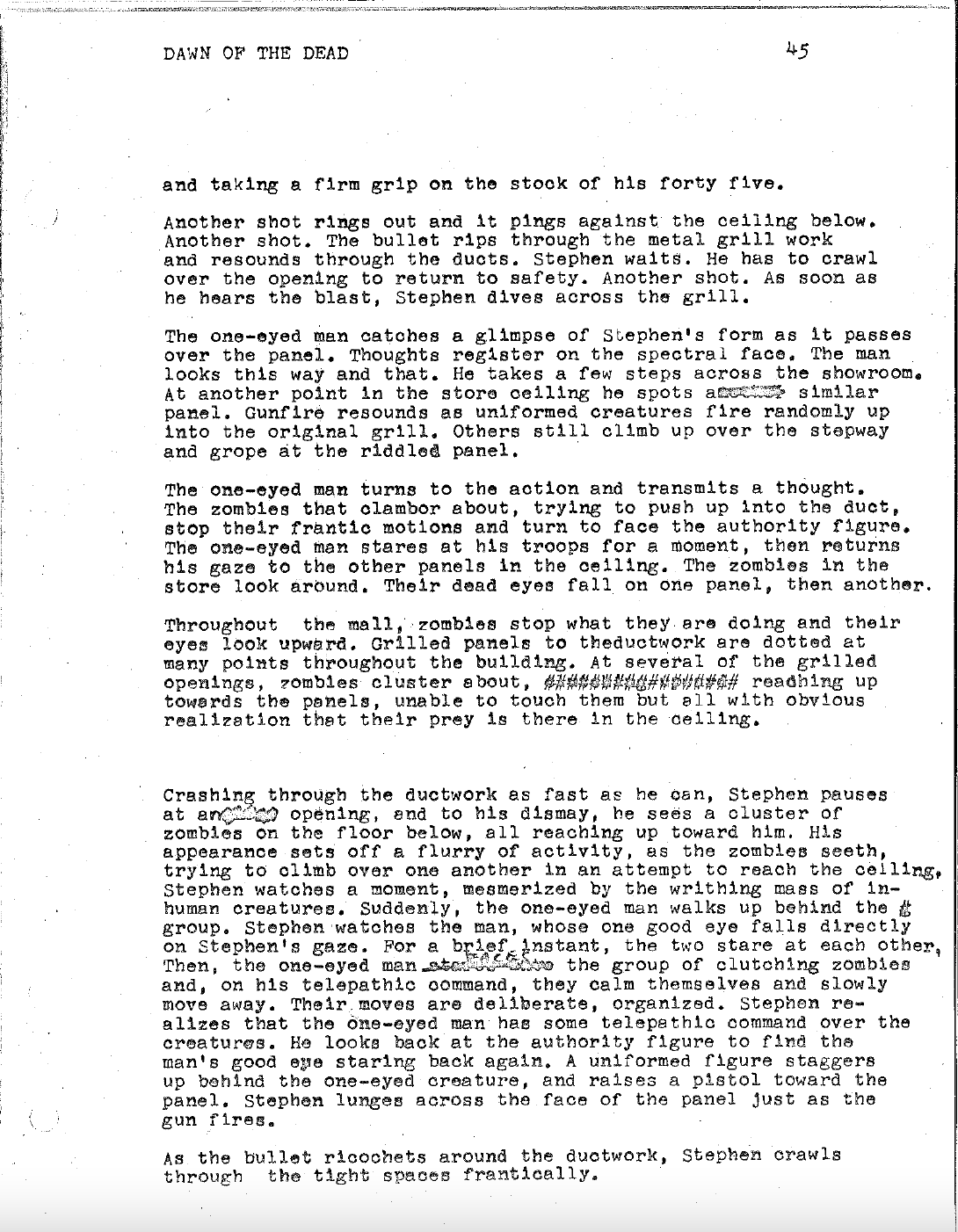
Again, there is a terminological shell game going on here: are these “figures” or “personages” zombies or human? Romero will refer to the figure in black as a “man” but we’ve seen that he will sometimes use that to describe the undead. Regardless of his official status, part of his mystery is that he is a figure with characteristics of both human and zombie, but also something different, as Steve discovers in their first encounter. The one-eyed man “transmits a thought” and sends a clump of zombies after Steve as he climbs above them in the ductwork. Through an opening, Steve looks down and meets the stranger’s gaze: “For a brief instant, the two stare at each other. Then, the one-eyed man faces the group of clutching zombies and, on his telepathic command, they calm themselves and slowly move away. Their moves are deliberate, organized. Stephen realizes that the one-eyed man has some telepathic command over the creatures. He looks back at the authority figure to find the man’s good eye staring back again.”

In their second encounter, Steve attempts to fire on the stranger unseen from afar but the stranger keeps throwing his hands up and flinching, before retreating into his car. His jaw hanging open in disbelief, Steve realizes that the stranger can read his mind too. The treatment ends before we get a glimpse at the inner workings of this zombie society beyond this figure straight out of White Zombie controlling an army of zombies, before we see everything that the guards are protecting.

The injection of a supernatural telepath into a straightforward zombie movie is a wild idea, one that would significantly alter the tone and scope of the story. In retrospect it seems like a curiosity, a distraction and a dead end that Romero apparently never resolved within the script, and which he therefore excised from later drafts. But it's FASCINATING to conjecture where he would have taken this story, and what it would have looked like. But it also shows how much Romero wanted to do something completely different with his second Dead film. He wanted to push his "zombie" film into the territory of action films, of fantasy, to not limit himself by the expectations placed on him by the genre. 


*: At one point in the script, Romero mistakenly refers to Steve as "David," which he had crossed out and corrected by hand. Those sorts of slip-ups happen for any writer, of course, but "David" is the name of the hero in his previous film, The Crazies, and this feels like a potentially revealing mistake. It suggests a similarity between the two, that perhaps the confusion came because Romero was thinking about them as analogous characters. It's pure speculation, of course, but this Steve is indeed far closer as a character to The Crazies' David than he is to the eventual "Flyboy" of the finished film. 


-Adam Charles Hart
Updated:
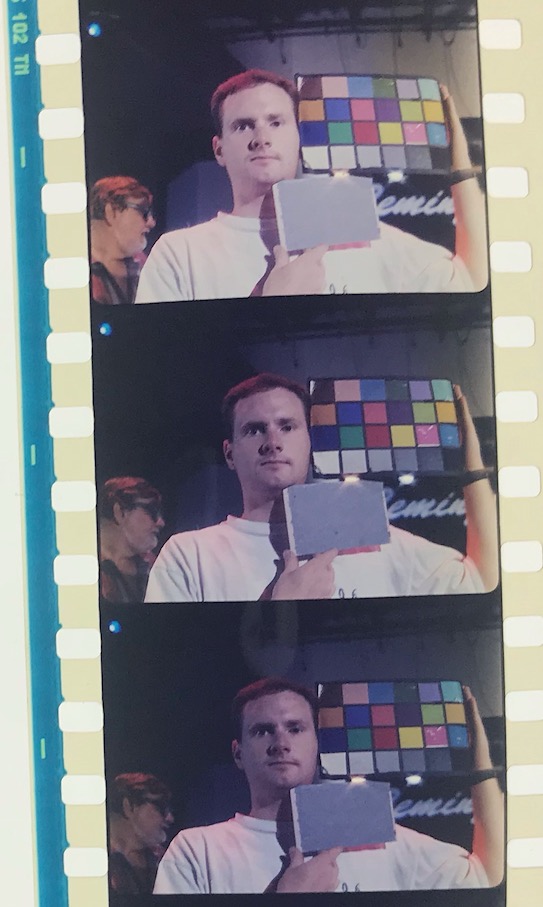
George Romero on set during the filming of Jacaranda Joe.

Last week, the University of Pittsburgh Library System received original 35mm camera footage from the filming of Jacaranda Joe, George Romero's lost film. The film requires an assessment and preservation work before we can examine it in depth, but, for the moment, here's a remarkable look behind the scenes of the studio used by Valencia Community College. Take a look at the guy in the background!

Updated:
George Romero's Gunperson script.

In the Archive, we have a screenplay titled Gunperson, a treasured project for Romero that he would talk wistfully about for the rest of his life. The screenplay is dated 1978, but mentions of the project go all the way back to August 17, 1973, when the Pittsburgh Post-Gazette shared the news that Romero had “received word that his Western script, ‘Gunperson,’ will be shot in Israel on sets recently used by Gregory Peck’s independent company, as an American-German-French-Israeli coproduction, slated for shooting late this year.” According to Romero, they were considering “name talent,” including legendary Italian star Claudia Cardinale.

(Also in this article, written by arts & culture columnist George Anderson, Romero shares that the Latent Image, along with Communicators Pittsburgh, was negotiating to produce an adaptation of Kristin Hunter’s The Soul Brothers and Sister Lou, to possibly be directed by Ossie Davis! In addition to their “steady diet” of commercials and sponsored films, the still-new Laurel was seeking to expand its production slate beyond Romero.)

Like many of the cinephile directors of his generation, Romero adored Westerns. This was the earliest true Western script that we have in the Archive, and he seems to have tried to get it made throughout the rest of the 1970s, as Laurel still had it on their production slate in 1980. He’d try again to make a Western in the 1990s, working with co-writer William B. Farmer on a screenplay called Quevira. And there are a handful of other projects that incorporated Western elements, even if there weren’t literal cowboys and it wasn't set in the Wild West. The closest he’d get to actually making one was his final film, Survival of the Dead, but elements crept into many of his zombie projects. The early versions of Day of the Dead in particular have strong Western tropes, most explicitly in the figure of Bub, a zombie who is a trained sharpshooter described in one draft as wearing "Western-style gun belts" with six-shooters holstered on each side.

Gunperson was a gender-flipped riff on The Magnificent Seven, close enough to its predecessor that the second paragraph of the script shouts out Elmer Bernstein’s iconic score. But it’s not gender-flipped in the sense that Ocean’s 8 or the Melissa McCarthy Ghostbusters is. Gunperson takes place in a world in which the entire society has switched gender roles. Women fill all the positions traditionally occupied by men in a typical Western scene, and vice-versa, as we see in our introduction to the Twisted Arm saloon:

… the scene is from every familiar western we’ve ever seen. People lean over the bar, laughing and swilling from jiggers as the bartenders pours generous glassfuls. Gamblers stand at dice tables, and others sit in poker games. The piano player chugs a beer with one hand, playing on the keys with the other. The difference in this scene is that these people are all women. Dressed in the traditional, male western garb, drinking, smoking gambling, but all women. The only man is a singer who tries to keep up with the lady piano player’s tempo.

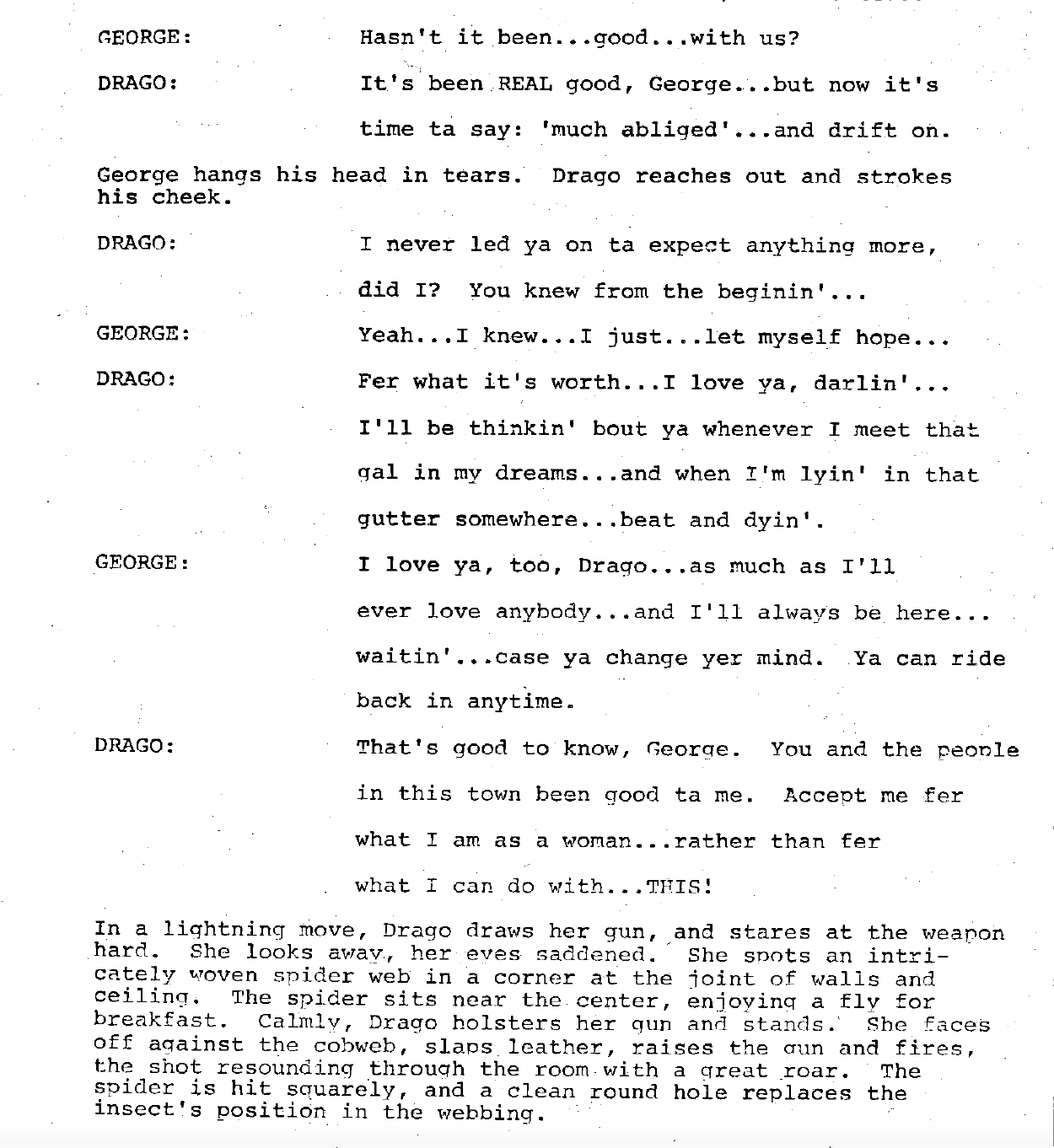
The film’s setup is typical of Westerns from an older era, in which a community is threatened by natives - here, a group of bandits let by an Apache woman named Azuma. As in The Magnificent Seven (or Akira Kurosawa’s The Seven Samurai) before that, the threatened community hires a group of gunfighters to save their village. In taking the job, one of the gunfighters, Drago, leaves behind her lovesick boyfriend George, telling him that “You and the people in this town been good ta me. Accept me fer what I am as a woman…rather than fer what I can do with…THIS!” as she pulls out her gun.

Despite the script featuring artifacts from an older era of Westerns, the supposedly villainous Azuma is a charismatic leader who only needs food for her community. She repeatedly offers Drago the opportunity for her and her comrades to walk away from the fight, or even to join her, as they seem to get along fantastically well. The climactic gunfight ends with Azuma’s death, but the two of them end their story by expressing their mutual respect and affection for each other, calling each other "friend":

AZUMA: Nice work with you Drago (cough)…

She dies.

DRAGO: Nice workin with YOU, Apache. Yore the last ‘o yore kind. I’m proud to have gunned ya.

Drago buries Azuma alongside her own fallen friends from the battle. She and one of the other survivors ride off in the direction of Mexico, where they’ve heard about some “action south o’ the border. Gal by the name of Villa.” Another rider drops out – at least for the time being – because although she wants to join, she thinks she might be pregnant. The duo end the film discussing how lucky they are to have the freedom to ride wherever they want “without lookin’ back. Just lookin’ ahead.”


-Adam Charles Hart

Updated:
Joseph Brenner Associates announces BLOOD

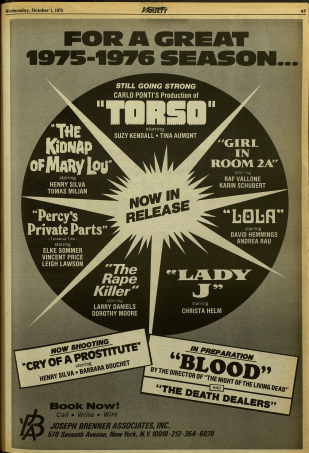
In July 1975, distributor Joseph Brenner announced that he would be co-producing tne new film from George A. Romero, and that it would be filming shortly. Brenner was known primarily as a distributor of horror movies, and in the 19790s he was carving out a special niche for himself within the genre as the American distributor of Italian horror films. But he was starting to branch out into production. In October of that year, he took out a full page ad in Variety announcing the full slate of releases from Joseph Brenner Associates, Inc. The pride of place was granted to Italian horror auteur Sergio Martino's Torso - a bloody horror film, yes, but one that carried with it the imprimatur of the legendary producer Carlo Ponti. In the bottom right hand corner is a notice that Blood, "by the director of 'The Night of the Living Dead'" is "in preparation." 

George Anderson, a local arts and culture columnist at the Pittsburgh Post-Gazette, spoke to Romero about the project after that Variety ad, who confirmed that Blood was indeed "on his schedule." But the demands of his television work, which included filming for the sports documentary Tom Weiskopf: On Tour and for a Homestead-filmed magic special called Magic at the Roxy, would keep him busy throughout until the end of 1975.

It's unclear what happened with Brenner, but it seems that, after 1975, he got out of production to focus on distribution. Romero wrote two very short treatments for Blood. The first is only 13 pages, and it is about a buttoned-down middle aged real estate agent who finds himself developing strange symptoms that closely resumble drug withdrawal. He finds himself feeling unfamiliar desires - sexual, in part, but also something else. These desire and his jittery discomfort build until he explodes in violence, killing his business partner and drinking his blood. With the help of his Romanian grandfather, Tati Voda, I've written a bit about this in another context, but, briefly, the protagonist finds his life spiraling out of control at an increasingly rapid pace: his relationship with his wife disintegrates, he moves in with a sex worker, and, of course, he continues feeding, needing to drink blood to maintain anything resembling normalcy. His name is Martin Mathias.

The second treatment is even shorter - only four pages - but it is the first version that resembles what would become Martin. The character of Martin Mathias is here a 300-year-old vampire who appears to be 30. Much of this treatment is devoted to imagining the logistics of a "realistic" vampire, in which there's no magic beyond his lifespan and his need to feed on human blood. He works as a drug dealer and a pimp and feeds every five or six weeks, at which point the need leaves him "strung out and shaking, like a drug addict, and he is forced to take blood."

Martin would be filmed in 1976 as an ultra-low budget production in Braddock, using locations that were either donated or bartered for and a cast of locals including Pittsburgh theatrical mainstay Lincoln Maazell (with whom Romero had worked on The Amusement Park), Tom Savini, Romero's wife Christine, and a young actor from Point Park University named John Amplas. It was shot on 16mm film, at least in part on film stock "embezzled" from the TV productions. It was Romero's first feature since The Crazies, which had been completed in 1973 but had hardly received a release until 1976. Martin did find a distributor, the small independent Libra Films. But despite receiving some positive attention, Martin was overshadowed by the unexpected success of another of Libra's releases, David Lynch's Eraserhead. A tiny outfit like Libra had to focus nearly all of its efforts into supporting and promoting the surprise hit of 1977-1978, and Martin never found its audience outside of devoted cinephiles who have managed to track down out of print or foreign video releases. But among Romero aficianados, it's beloved, treasured as perhaps his most personal film. 


-Adam Charles Hart

Updated:
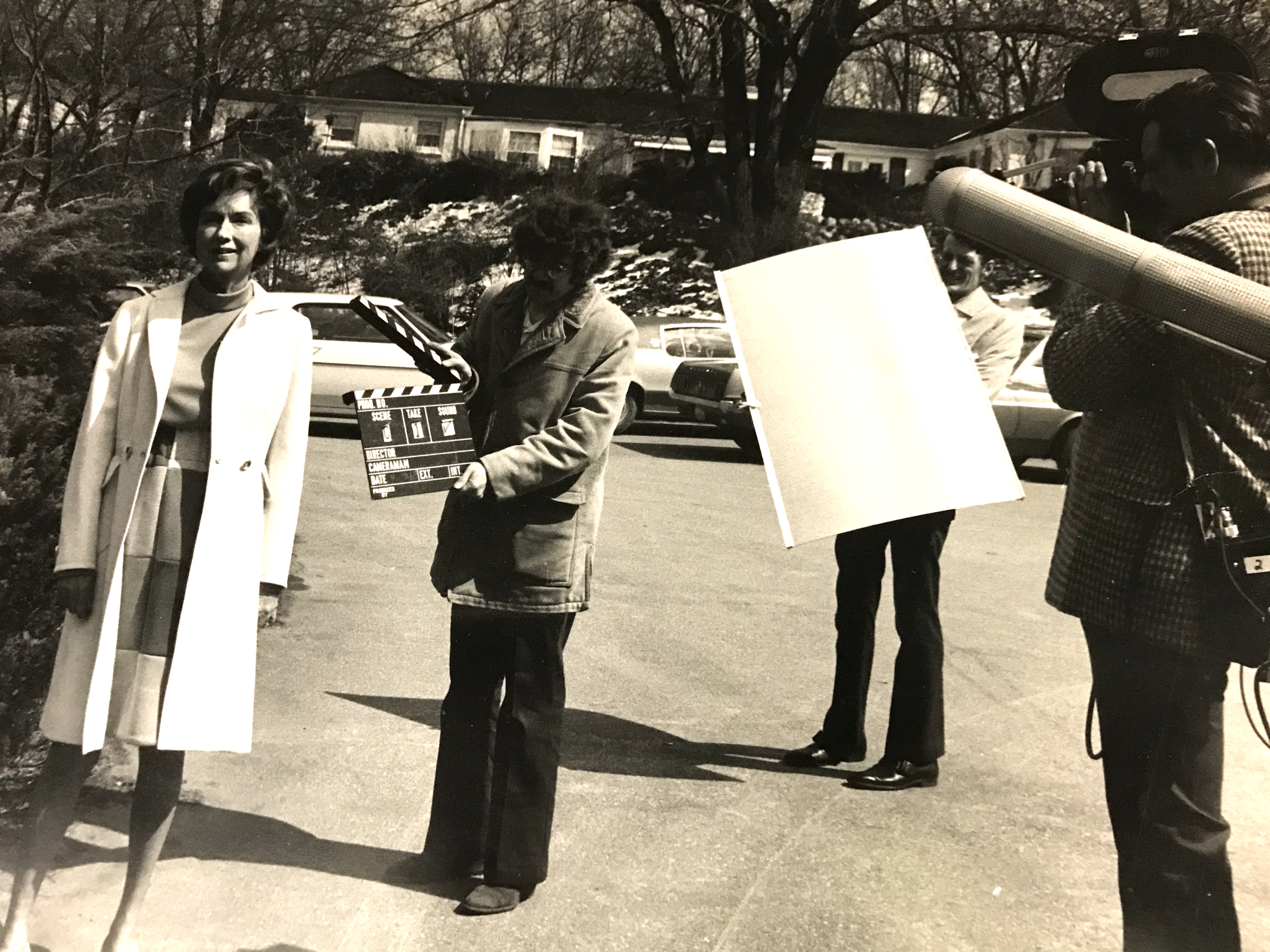
George Romero & co. filming Lenore Romney for her 1970 senatorial campaign.

Throughout the 1960s, George Romero, Russ Streiner, John Russo, and the other Pittsburghers who would would form The Latent Image made a name for themselves as the city's premiere makers of commercials. We have a number of them in the archive, including restored versions on 16mm film of a handful. Some have been released on home video as DVD extras, some have found their way onto YouTube. The most widely-seen is a delightful spoof of undersea adventure films that they called "The Calgon Story," a fairly high budget production for the Pittsburgh team. Romero would later claim that in "the period from '62 to '68, we cranked out countless commercials and industrial films. I directed and edited more film (as measured by running time) in that period that my entire filmography of published work....by at least three times."

What's less known, however, is that Night of the Living Dead did not mark the end of Romero & co.'s sponsored work. It actually helped them to gain a foothold for a handful of high profile regional and national clients, including multiple political commissions. The Latent Image produced a number of commercials and a campaign film for Albert Brewer, who challenged segregationist George Wallace in Alabama's gubernatorial election. There were several Pennsylvania campaigns that they worked with. But the highest profile political work at the time has now been almost wholly forgotten: the 1970 senatorial campaign in Michigan for Republican Lenore Romney. Romney had almost no political experience, but she was the well-loved wife of a popular former Governor working in Nixon's White House, George Romney. Both George and their son Mitt, then still in college, would contribute to Romney's efforts.

The film that Romero directed for her campaign, Lenore, exists only in a handful of political archives (there appears to be a copy in George Romney's archives), and has probably only been seen a handful of times since 1970, when it was broadcast a number of times on Michigan television. From what we've been told by Romero's collaborators and what we can glean from the campaign film's reviews, the film seems to be more about the charming personality of Romney - a onetime Hollywood actress - than it is about her politics. In the words of the Wall Street Journal: 

The narrator is asking, "What kind of Senator will Lenore Romney make? How does she qualify and where does she stand?"

Good questions, thinks the viewer. After all, the 60-year-old lady, pleasant though she is, has never held an elective office and apparently is running this year against veteran Democratic Sen. Philip Hart only because her husband, former Governor George Romney, decided he didn't want to. 

So the viewer settles back to await the answers. What he gets, instead, is a living-color snow job, a masterpiece of that rapidly developing branch of the cinema aimed at creating desirable images for politicians. 

We don't have a copy of the film itself in the archive, and no production materials or correspondence to reveal how George Romero ended up working for Lenore Romney. Confirming the mere existence of Lenore required a bit of detective work. First, we found a number of large format photographs of Romero, Gary Streiner, John Russo, and other Latent Image filmmakers from the streets of Washington, D.C. The initial assumption was that these might be from Night of the Living Dead's Washington scenes. But these photographs seemed to be of the Latent Image crew not just filming but interviewing actual, identifiable politicians, including future President Gerald Ford. A blown-up photograph of Romero with Gerald Ford was not something we expected to find, to say the least!!

But there were a handful of copies of the Wall Street Journal review. One of them was pasted onto a blank paper with the words "Director: George Romero" on it. But I could find no mention of it in the published filmographies. There was a single interview we found in which Romero offhandedly mentions that they "got into political campaigns. We worked with the real political kingmakers, the guys who brought you Nixon '68. We did Lenore Romney in Michigan. We did Albert Brewer against Wallace in Alabama, the year he won and they recalled it and said, 'No you didn't win.' We all had to get haircuts; cracker-barrel stuff.* To me it was service work. I still don't have compunctions about doing that. We were hired guns; it was either that or selling beer." Eventually, we discovered publicity that was produced in the early 1970s for Romero's new projects, in which his brief biography confirmed Lenore as a production from 1970. At that point we felt comfortable approaching Romero's collaborators to ask about what otherwise would have seemed like a non-sequitur. 

* Romero is being literal: there are numerous commercials for Albert Brewer's campaign that were shot in Cracker Barrel restaurants. The reels containing those spots are labelled "Brewer Cracker Barrel."


-Adam Charles Hart