Articles

Updated:
Creepshow: meteors and monsters image

It is no secret that George Romero and Stephen King enjoyed a close friendship and admired one another’s work.  This is perhaps to be expected from two of the most influential voices in horror.  Their friendship and mutual admiration led them to many ambitious plans to collaborate on projects, perhaps the most successful of which was the anthology film Creepshow in 1982.  An homage to the EC Comics of their childhoods, the film is perfect example of blending horror and comedy and truly lived up its tagline of ‘the most fun you’ll have being scared’.

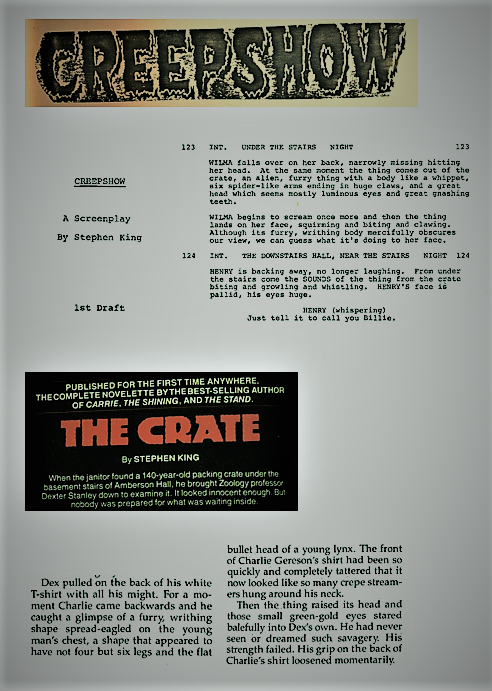
King wrote the screenplay in 1979 in which he adapted two of his own short stories for the screen (the other three segments and the frame story were original for the screenplay).  The two adapted tales, “The Crate” and “The Lonesome Death of Jordy Verrill” (published in story form as “Weeds”), offer an opportunity for further exploration.

Despite the success of Creepshow, and the fanfare of these two segments in particular, the original short stories remain among King’s more elusive writings.  They have never been included in any of his collections and have only appeared in a few hard-to-find anthologies or limited edition, small press collections.  Both originally appeared in men’s magazines – “Weeds” in Cavalier in May 1976 and “The Crate” in Gallery in July 1979.  This was common practice at the time, particularly for newer writers and genre fiction, and indeed many of King’s early stories appeared in men’s magazines before being collected or reprinted elsewhere.  Many of these magazines followed the lead established by Playboy and included fiction and political writings alongside the pictorials (hence the running joke of just having the magazines to read the articles was not entirely a stretch).  While common, it also leads to a rather humorous incongruity between the way in which one encountered the original piece (interspersed between nude pictorials and sex columns) versus the film (presented as a comic read by a child).  Although, perhaps one might find similarities among the advertisements such as x-ray specs to see through clothes (comic books) or how to use hypnotism to convince women to fall for you (a real ad appearing among the pages of “The Crate”).

The stories themselves are fairly faithful adaptations.  The short story ‘Weeds’ is much darker than its screen counterpart.  Jordy does retain some of the same yokel-ish qualities that provide for some levity (for example, his exclamations of ‘lunkhead’ and his disgust over ‘meteor shit’ on his hand), but overall the general poverty in which he lives mixed with the increasing direness he finds himself in as he transforms casts a pall over the story that leaves the reader feeling drained.  The film takes a lighter tone, due in part to King’s own portrayal of Jordy.  As seems to be his style when on-screen, King heavily plays up the yokel qualities to noticeably lighten the mood of the story.  While the story does include Jordy hoping to make money from the University, the added sight gag of Jordy showing up with his bucket to the Department of Meteors in particular shifts the mood from tragic to farcical.  Even Jordy’s eventual demise by his own hand somehow feels less bleak on screen due to the overall tone set throughout the segment.

“The Crate” in story form is much more streamlined and focuses only on the relationship between and the retelling of stories by the two main characters, Dex and Henry, without much of the framing and character-building scenes (such as the garden party).  Although in a testament to her abilities, it is impossible to read “The Crate” now and not hear Adrienne Barbeau’s acerbic voice come through in her fantastic performance as Billie despite only have a few lines of dialogue in the story.  As an aside, her iconic threat to wear Henry’s balls as earrings was ad-libbed by Barbeau; it was so memorable that it was later scripted for her character to use in an episode of the soap General Hospital.  Perhaps the most interesting aspect of “The Crate” is the development of Fluffy.  In neither the short story nor the original screenplay does the beast have the sort of primate features that it does in the film.  Rather it is a furry six-legged beast with either feline or canine features: in the story it is described as having a “bullet head of a young lynx” while in the screenplay with “a body like a whippet”.  Additionally, the screenplay gives it “spider-like arms ending in huge claws”.  This spider-like description almost seems reminiscent of the ‘true’ form of IT encountered by the Losers Club in the sewers.  It should be noted that Romero flatly disliked the spider-ish qualities in both instances, although the eventual design of Fluffy was more the result of Tom Savini’s creative aesthetic than direction from either King or Romero. 

Ultimately, Creepshow remains Romero’s most fun film and stands as a testament of the collaborative spirit and camaraderie among two horror masters.  The two would continue to work together over the next two decades on projects both produced and unrealized.   

Ben Rubin
Updated:
Dead Reckoning: the origins of Land of the Dead script image

In 2005, after a 20-year hiatus, Romero returned to his zombie universe with Land of the Dead.  The film was the biggest budget entry into the Dead series and featured Pittsburgh in its most prominent role despite being the first of the series filmed entirely outside of the region.  The film continues the bleak tone of Day as it depicts a stratified Pittsburgh with the rich living in safety and luxury within the fortified and barricaded Golden Triangle of Downtown Pittsburgh, while the rest of society toils amongst slums outside the gates with threats both human and undead.

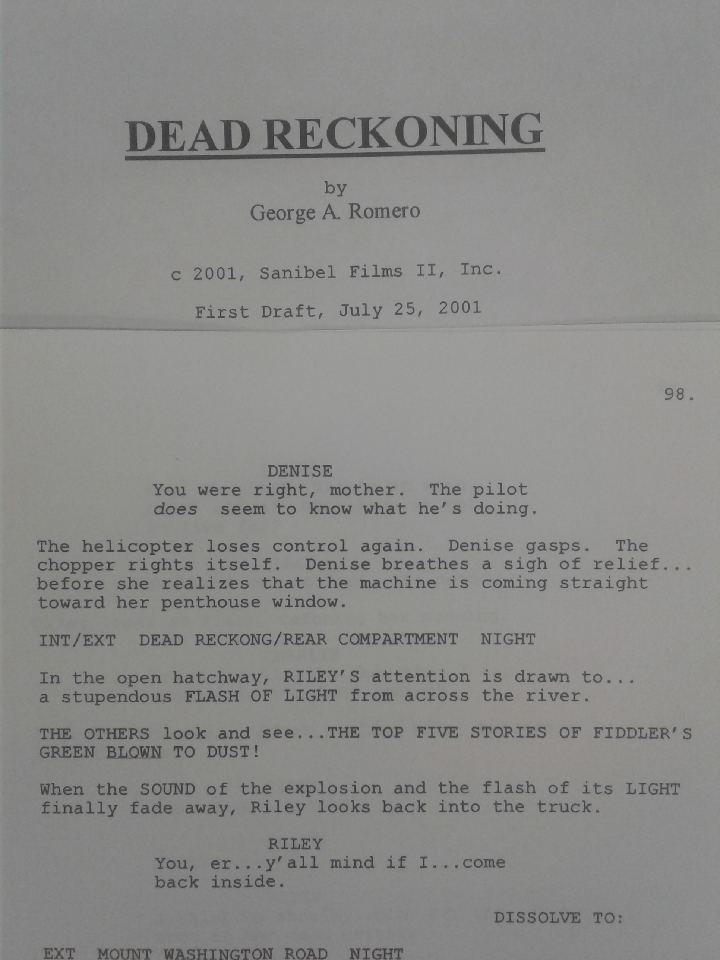
The roots of the film date back to July 25, 2001 and the initial drafts present a different story than what fans know as Land of the Dead.  The project was originally titled ‘Dead Reckoning’ after the vehicle of the same name in the film.  Romero has stated in interviews that he did not want to continue the use of the ‘of the dead’ format but was later convinced to return to it.  This first imaging as ‘Dead Reckoning’ has some fascinating differences worth highlighting.

  • An opening scene that went right for the scares: Riley lying in bed with a woman; she climbs on top to straddle him and he is suddenly faced with a zombie dropping maggots onto his face! Riley bolts awake and the audience realizes it is a dream.  This surely would have been a memorable jump scare to reignite the franchise with a bold statement of zombie carnage.  Alas, the studio did not like the opening and provided the feedback “let’s not open with implied necrophilia”.
  • Differences in characters and dynamics:  Riley was originally meant to be an African American lead and embodied many of the traits that are later distributed among several characters.  Riley and Cholo are always at odds and the main conflict is between them with very little between Kaufman and Cholo.  Kaufman is not the supreme leader of Fiddler’s Green but one of many (although he does eventually solidify his control).  Slack is a mercenary employed by Kaufman to assist Riley in capturing and retuning Dead Reckoning and doesn’t show up till over halfway through the film.
  • No zombie army! One of the most iconic aspects of Land of the Dead is Big Daddy and his zombie army, but they were completely absent from the original script.  Indeed it is hard to imagine the film without the scene of the zombie army rising from the river.  Instead, we get one scene in a basement laboratory in which zombies are being experimented on in ways that resemble Day of the Dead.  The lead scientist expresses excitement over having trained one zombie to eat cat food rather than human flesh.  At least until a later scene when the scientist is distracted and the lust for flesh returns and the zombie dispatches him in familiar gruesome fashion. 
  • A much more explosive ending: the climax of the story plays out in a much different manner.  Dead Reckoning is mostly destroyed atop Mt Washington, killing Cholo along with it.  The vehicle is in three segments and mercenaries destroy the segment containing Cholo just before he can launch missiles at Fiddler’s Green.  Riley and Charlie then destroy the middle section containing the rest of Cholo’s crew before driving off in the caboose setting off fireworks on their way to Canada.  The studio pushed back that this ending was unsatisfying as it lacked any cathartic confrontation between the protagonists and antagonists.  Meanwhile, in Fiddler’s Green, Kaufman and the other elites plan to escape the city by helicopter as it is obvious the zombies are loose from the basement lab and taking over the building.  One helicopter leaves but the pilot is killed by a stowaway zombie causing the chopper to go off course and crash into the Green, exploding, and destroying the top of the building and Kaufman with it.  While not stated outright in any studio response, one might suspect that this ending became untenable after the world events just a few months later.

A few revisions of this version continue through October 2001 followed by a long hiatus.  The project reemerges in January 2003 under the name Land of the Dead and follows the shifted storyline that we are familiar with from the film released in June of 2005. 

-Ben Rubin

Updated:
George A. Romero's Zombisodes.

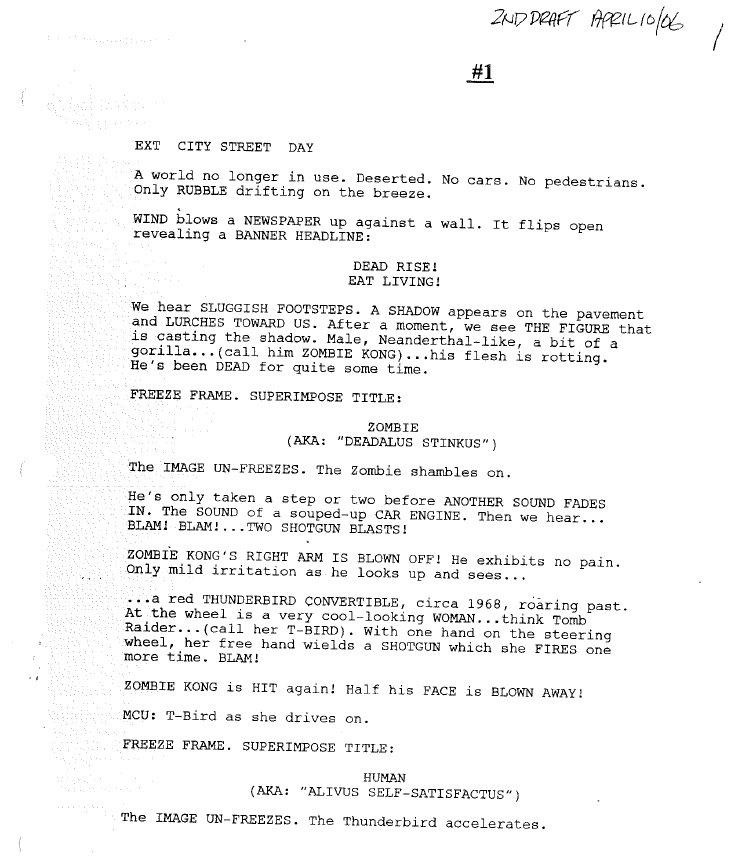
In 2006, Romero wrote several treatments for a proposed television series called, alternately, Zombisodes and Zomboid. The script is a cartoonish burlesque on zombie movies whose hapless undead protagonist is slashed, shot, blown up, crushed, run over, and otherwise punished over and over again. His jokey introduction sets the tone:

A world no longer in use. Deserted. No Cars. No pedestrians. Only RUBBLE drifting on the breeze.

WIND blows a NEWSPAPER up against a wall. It flips open revealing a BANNER HEADLINE:

            DEAD RISE!

            EAT LIVING!

We hear SLUGGISH FOOTSTEPS. A SHADOW appears on the pavement and LURCHES TOWARD US. After a moment, we see THE FIGURE that is casting the shadow. Male, Neanderthal-like, a bit of a gorilla… (call him ZOMBIE KONG)… his flesh is rotting. He’s been DEAD for quite some time.

FREEZE FRAME. SUPERIMPOSE TITLE:

            ZOMBIE

            (AKA: “DEADALUS STINKUS”)

The IMAGE UN-FREEZES. The Zombie shambles on.

Like Wile E. Coyote or Itchy and Scratchy, Zombie Kong exists solely to combat his nemesis, a woman the script dubs “T-Bird.” Zombie Kong isn’t particularly zombie-like in some ways: he cannot speak (though his inarticulate grunts are translated with subtitles), and he wants to eat T-Bird, but he’s also smart. He knows how to use complex tools. He devises intricate plans involving vehicles and weapons, all of which are foiled, either by T-Bird or be happenstance. He can operate cars and hot air balloons! He can plant explosives and fire torpedoes and set hilariously elaborate traps. The most narratively important aspect of his zombie-hood seems to be his ability to take punishment. He sustains such extreme injuries that he barely maintains bodily integrity. And yet he manages to carry on, holding the steering wheel with his teeth or using a wheelchair when necessary.

With each episode, Zombie Kong gets more and more exasperated, and he sustains increasingly absurd damage. The last few episodes end with explosions, with the 15th ending with several successive torpedo misfires. The first comes after Zombie Kong has, with great care and delicacy, set up a torpedo for T-Bird to run over when she passes. As the legless Zombie Kong begins to crawl away a crow flies overhead, and as it passes directly over him, it shits:

Zombie Kong cringes and squints his eye shut…

…assuming that the glob of shit is going to hit him.

It doesn’t.

It drifts on the wind…

…and hits the torpedo instead.

Squarely on its half-submerged blasting cap…

…with Zombie Kong still well within range.

KA-BLOOOOOOOOOOOOM!


The 18th and final episode ending with an enormous stockpile of grenades, bombs, and the like being struck by a lighting bolt before T-Bird comes into range, setting off “an EXPLOSION equivalent to Hiroshima.”

In 2006, Romero was already at work on Diary, and he would make Survival of the Dead not long after that. After that, he would work with Steven Schlozman to adapt Schlozman’s novel The Zombie Autopsies into a film. He would write the Empire of the Dead comic and would begin the novel The Living Dead – completed after Romero’s death by Daniel Kraus.

Romero would sketch out ideas for another zombie movie, Twilight of the Dead, that takes place in an all-zombie village in which Big Daddy from Land of the Dead leads a zombie society onto which a lone surviving human stumbles. That story incorporates some elements of his early Kubrick-inspired writing about protohuman societies (including The Footage). That brief synopsis suggests an increasingly pessimistic approach to zombies writ large. Twilight’s zombies have not just formed a society, they have learned to live together, and alongside humans. Or, at least, the couple of humans they’ve encountered since the fall of Fiddler’s Green. The bulk of the story implies an almost utopian vision, the re-starting of civilization that Romero so often seems to yearn for in his zombie work. Big Daddy is a benevolent but stern leader, and the inhabitants of the village live together in peace. But things begin to disintegrate when invaders – also zombies – arrive at the village. It ends with the two groups of zombies at war, a pile of twice-dead bodies alongside the few who remain standing and fighting. Romero’s utopian vision has fractured, the zombies fighting among themselves just like the humans had. Humanity is doomed, even after its death.

Of all of these zombie projects, Zombisodes stands out for the ways in which it departs from and mocks the legacy of zombie movies. It’s funny and absurd, and it seems unlikely that it would ever be made. In casting a zombie as a decomposing Wile E. Coyote who loses most of his limbs, he created a scenario that could not have been realized in live action without a fairly massive special effects budget, and which was likely far too violent and gross for a cartoon. Writing several series of drafts seems to indicate that, at some level, Romero was serious about the project, or at least that he enjoyed writing it. However, it’s unclear who would have funded it. It could potentially be scaled down a bit to be realized on a fairly low budget, as there were literally only two characters, the setting was an open landscape, and the explosions and bodily destructions could be tempered somewhat for a television audience. But in 2006, networks weren’t looking for slapstick gore. 

The episodes are funny, and often corny, with its humor built around the increasingly elaborate, incessant destruction of Zombie Kong’s body. Silly as they are, there is in these drafts a kind of sadistic delight being taken in the litany of injuries and humiliations piled upon the zombie, composed not long after Romero’s return to the undead with Land.  He was clearly injecting some legitimate variety into the zombie formula, but perhaps also working out some frustration. It is hard not to see the script as punishment being inflicted not just on Zombie Kong, but on zombies writ large, a kind of therapeutic annihilation of the albatross that had been hanging around his neck for almost 40 years at that point. At the very least, it joyously stomps on the legacy of the undead.


- Adam Charles Hart

Updated:

The University of Pittsburgh Library System (ULS) is pleased to announce several significant new acquisitions to its Horror Studies Collection.

First announced during an installment of the ULS Horror Studies Webinar Series, hosted in collaboration with Pitt’s Center for African American Poetry and Poetics (CAAPP), the ULS has acquired the papers of Linda D. Addison, the most decorated horror poet today with a total of six Bram Stoker literary awards. Addison became the first African American writer to win a Stoker in 2001 for her collection, Consumed, Reduced to Beautiful Grey Ashes and has also received the Lifetime Achievement (2018) and Mentor of the Year (2016) Awards from the Horror Writers Association as well as the title Grand Master from the Science Fiction and Fantasy Poetry Association (2020). Her poetry explores themes of race, gender, loss, struggle, hope, and the resiliency of humanity through a lyrical style that employs both traditional horror tropes of the supernatural as well as stark realism. Her archive will include drafts and manuscripts of her poetry as well as ephemera such as convention programs and awards which help demonstrate her impact on the genre. On her hopes that her archive will inspire others, she says:

Having my writing journey from journals, through edits to final versions, become part of the University of Pittsburgh Horror Studies Collection is a dream, I never imagined, come true! To think that others, studying my process, could find value and inspiration will allow my work to safely exist past the length of my life, is an incredible blessing.

The ULS has also acquired the papers of Kathe Koja, who is a true iconoclast whose works push boundaries, expand our conceptions of horror, and prove that horror is indeed a true literary genre. Her first novel, The Cipher (1991), won both a Bram Stoker Award and Locus Award and solidified her impact as a force within new horror. She employs a striking and unique prose style to explore themes of alienation and social isolation as well as transcendence, often through art. Her collection will include drafts, manuscripts, and notes from her novels and short stories. On her decision to establish her archive at the University of Pittsburgh, Koja said:

A book is its writing as well as its words: the thoughts and notes and drafts and edits (and edits, and edits) that comprise the final text. To have all that making made available for scholars, readers, and fans of horror literature is a real boon, and I'm beyond delighted that my own horror novels will now be available this way.

Lastly, the ULS has acquired the archives of the Horror Writers Association (HWA), the premiere professional organization for writers working in the genre.  This collection, established by current HWA President John Palisano with support from former President Lisa Morton, documents the history of the organization through its newsletters, convention booklets and programs, and other published materials. Collectively, these materials illustrate the work of the HWA, as well as the community it has built. The HWA has been the main space for writers working within the genre to collect and collaborate since the late 1980s and has issued the Bram Stoker literary awards since 1987 at yearly conventions, such as the World Horror Convention and, since 2016, StokerCon.

Horror Studies Collection Coordinator Ben Rubin recently announced the acquisition of the HWA and Koja archives at StokerCon2021, where he participated in a live panel discussion about the archives, the potential for research, and their importance in bringing legitimacy to a genre often maligned during StokerCon along with Addison, Koja, and Palisano. Says Rubin:

These collections represent significant steps forward in developing the horror studies collections. They highlight the diversity of the genre, not just in its creators, but also in the ways in which it interprets, explores, and exposes the complexity of the human condition through its fears and anxieties. Further, the HWA archives in particular serve to illustrate the strong sense of community, collaboration, and support within the horror literary community and how it has thrived.

Processing work will begin on these new collections in summer 2021.

- Ben Rubin

Updated:
George Romero's Goosebumps script.

In 1992, R.L. Stine debuted Welcome to Dead House, the first Goosebumps book. It was creepy, it was spooky, and it was MASSIVELY popular, introducing countless young readers to the horror genre and spawning a series that would sell hundreds of millions of copies around the world. For a stretch in the 1990s, Stine was the best-selling writer in America, aided in no small part by his incredible productivity, publishing dozens of books in that span. TV quickly pounced on it, with an ongoing series premiering in 1995. But it wasn't until 2015 that it hit the big screen. In the wake of the Goosebumps' initial sucess, George Romero was one of the filmmakers who explored the possibility of a feature film adaptation. That effort seemed to have eventually started moving forward with Tim Burton, but, according to Stine, the project was delayed by Burton's aborted Superman project and eventually abandoned. The exact timeline of the production and Romero's place within it is unclear, but Fox at one point placed a Goosebumps movie on their tentative release schedule for Halloween 1996.  (It seems unlikely that Burton's film would have used anything substantial from Romero's script. It would not have been uncommon for the studio to commission multiple scripts over the course of a few years, as Universal did with The Mummy, for which scripts were written and/or revised by Romero, John Sayles, Mick Garris, and Alan Ormsby, among others, resulting in a complicated arbitration process to determine the credited writers for the 1999 film.) The eventual Goosebumps film, written by Scott Alexander and Larry Karaszewski, takes a meta-approach, with Jack Black playing "R.L. Stine" in a town plagued by a host of monsters from his books. Romero's script was a far more straightforward adaptation of Welcome to Dead House, albeit one with a very distinct take on the story. 

The Stine book is set in a town called Dark Falls whose inhabitants are, secretly, the living dead. When the Benson family moves in, young Josh and Amanda discover that a flashlight beam is sufficient to crumble the town’s residents into dust. Every year, the town must feed on the blood of a new family to sustain their undead existence. Romero retains the basic scenario and all of the major character names but tweaks the story in revealing ways. In the Stine book, the zombification comes, a la Return of the Living Dead, because of a mysterious gas that escapes from a local factory. Romero makes the capitalistic origins more emphatic: the town patriarch, the wealthy Foster Devries, has in death possessed the town. The state of living death experienced by the residents stemmed from a supernatural power that Devries has now shared with/imposed on the town.

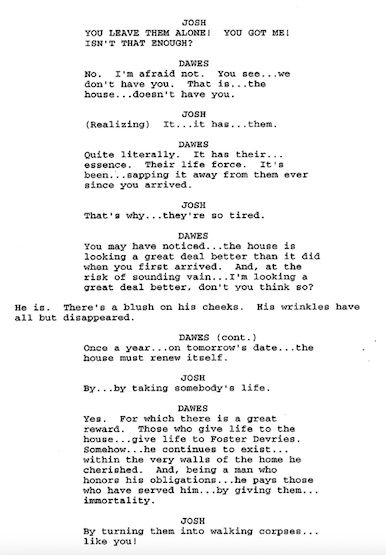
There were a handful of horror scenarios that Romero returned to repeatedly over the years but which never made their way into a finished film: bigfeet, golems, Frankenstein's monsters, etc. His version of Goosebumps picks up an idea that he had developed for years in a project called Apartment Living that came very close to production in the late 1980s, and which he would return to again: a house that is alive, and which feeds off of its inhabitants. Here, it's more accurate to say the house is undead, as it is possessed by Devries’ spirit. Devries/the house feeds off its inhabitants, sucking out their energy until they die, after which they are revived to join the rest of the undead in the town. The energy harvested from the inhabitants sustains the residents for another year. And escaping the town means defeating De Vries and his toadies, his loyal former employees who still do his bidding in exchange for this new form of wages. As town leader Compton Dawes tells Josh:

Those who give life to the house… give life to Foster Devries. Somehow… he continues to exist… within the very walls of the home he cherished. And, being a man who honors his obligations… he pays those who have served him… by giving them… immortality.

To which Josh responds, “By turning them into walking corpses… like you!"

Romero re-imagines Dark Falls as the ultimate company town, in which the townspeople are wholly reliant on their boss for their continued undead existence, but the scope of their new “eternal lives” are highly circumscribed, limited entirely to what Devries allows. That means remaining within the city limits and feeding him a new family every year. Unlike in the Stine version, the threat here is not that the inhabitants will simply kill them and drain their blood, but that they will be forced to join the town and “live” according to the requirements of the town. That means a loss of independence, no possibility for self-determination. There is a growing rift in the town, the children increasingly resentful of their parents but still, reluctantly, obedient. The disagreement is articulated in terms of the “future.” Dawes tries to lure Josh into joining them willingly by promising him a “bright future.” But after Josh has vanquished Devries and Dawes, Dawes’ daughter Karen appears along with the other undead children to apologize to him. “We saw you as… a threat to us…” she says, “because… that’s the way… our parents saw you. We shouldn’t have believed them.” Josh sees that they have begun to fade away and gets emotional, yelling “WHAT’S HAPPENING? WHERE ARE YOU GOING?” to which Karen responds:

Into the future. We just wanted to thank you, Joshua. For giving us that future. For giving us back… our lives. We’ll never forget you. Never.

The “future” that Josh has granted them seems to be, simply, death. Or, at least, freedom from the living death that has trapped them in their bland, limited existence in Dark Falls. The divide about the “future” between generations is one that seems to hinge on the question of what sort of existence is worthwhile. Dawes has embraced a future in which, as long as the town continues to follow the rules laid down by his boss, and as long as they find another family to victimize, they can continue living in their uncanny stasis. Romero’s nightmarish scenario here involves not being killed and eaten but, rather, essentially having an awful, soul-killing job. Living in Dark Falls means living a fundamentally compromised and circumscribed existence, one that forces you to contribute to the predatory, parasitic system by finding further victims. The freedom to die and enter whatever this film’s version of the afterlife is is freedom from being stuck working for their boss. 

Romero liked to talk about his Dead movies as taking stock of and analyzing America every decade or so. This wasn't a sequel to Night, Dawn, and Day, but it was a zombie movie. And in this return to zombies, Romero envisions a truly hellish nightmare: being stuck in an awful job with an overbearing boss for all eternity. In its way, the script seems just as incisive and insightful about 1990s America as its sorta predecessors did about their time, capturing something visceral about the growing demands on workers made by employers and the dangerous precarity lying just underneath the surface of all that apparent prosperity.


-Adam Charles Hart